
CORSIA verification: for international aviation emissions
The Carbon Offsetting and Reduction Scheme for International Aviation (CORSIA) is a global system for emissions reduction in aviation. The programme was adopted in 2016 during the 39th ICAO Assembly and forms an important international market-based measure to limit CO₂ emissions from international aviation.
CORSIA is laid down in Annex 16, Volume IV of the Chicago Convention and requires airlines to:
- Monitor and report emissions from international flights
- Offset emissions above the baseline through carbon offsets
The objective of CORSIA is to achieve carbon-neutral growth of international aviation. Each ICAO Member State appoints a national authority responsible for overseeing compliance with these obligations.
The most recent official templates for the Emissions Monitoring Plan, the Emissions Report, the Emissions Units Cancellation Report and the CORSIA Eligible Fuels Supplementary Information are available via the ICAO CORSIA website.
Our approach
Normec Verifavia supports airlines in meeting CORSIA obligations through independent verification of emissions reports.
Our services include, among other things:
- Verification of CORSIA Emissions Reports
- Assessment of Emissions Monitoring Plans
- Verification of CORSIA Eligible Fuel (CEF) claims
- Review of emissions and fuel data
Our verification processes are carried out according to international standards such as:
- ISO 17029:2019
- ISO 14065:2020
This ensures reliable and transparent verification of emissions data.
Climate regulations in aviation
CORSIA consists of three implementation phases:
- Pilot Phase (2021–2023) – voluntary participation by states
- First Phase (2024–2026) – voluntary participation remains possible
- Second Phase (2027–2035) – mandatory for most ICAO Member States
Aviation operators with annual CO₂ emissions of more than 10,000 tonnes from international flights and aircraft with a maximum take-off weight (MTOW) above 5,700 kg fall under the reporting obligations.
At the end of each three-year compliance cycle, operators must:
- Purchase and cancel emissions units
- Submit an Emissions Units Cancellation Report (EUCR)
- Submit a verified emissions report to the competent authority
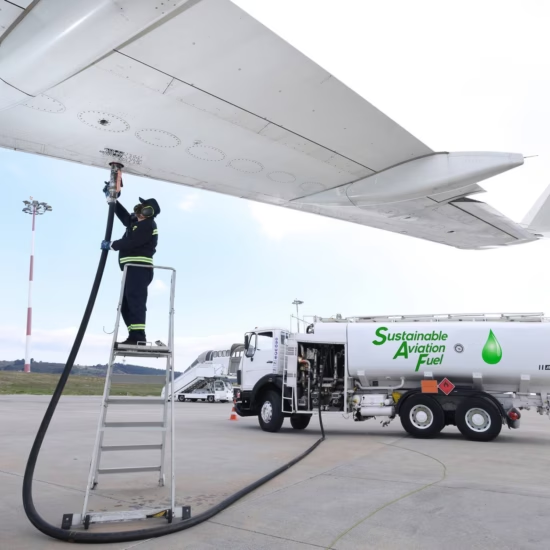
Operators can also claim emissions reductions through CORSIA Eligible Fuels (CEF), provided these meet ICAO sustainability criteria.
Independent verification of CORSIA reports offers clear advantages for aviation operators.
- You comply with international aviation regulations and reporting obligations
- You minimize compliance risks and potential sanctions
- You increase transparency towards regulators and stakeholders
- You strengthen the reliability of emissions data
- You support the sustainability of international aviation
Normec Verifavia's expertise
Normec Verifavia has more than ten years of experience in verification, validation and auditing within the aviation sector.
Our experts support operators worldwide with:
- CORSIA verification
- EU ETS verification for aviation
- Emissions monitoring
- Verification of alternative fuels
Thanks to our technical expertise and sector experience, we provide accurate, reliable and efficient verification services.
Would you like to know more about CORSIA?
Downloads
Frequently asked questions
-
Operators with annual CO₂ emissions greater than 10,000 tons from international flights and aircraft with a MTOW greater than 5,700 kg must report under CORSIA.
-
Among others, the following flights are exempt:
- Helicopter flights
- Military flights
- Humanitarian and emergency medical flights
- Police and state flights
- Fire department operations
-
The verified emissions report must be submitted to the competent authority by:
- March 31 for operators in the European Economic Area (EEA)
- April 30 for operators in the United Kingdom via the METS portal
-
At the end of each three-year cycle, operators must
- Purchase emission units.
- Cancel them by January 31 of the following year
- Submit a report on the cancellation of emission units
-
CORSIA-eligible fuels are sustainable aviation fuels that meet ICAO sustainability criteria. If operators use these fuels, they can claim emission reductions, provided these claims have been independently verified.
-
A market-based measure (MBM) is a financial mechanism used to reduce carbon emissions in aviation. Examples include emissions trading, emissions charges and emissions offsets. The goal is to achieve environmental objectives in a flexible and cost-effective manner, complementing traditional regulation.
-
CORSIA works with a route-based approach. This means that compensation obligations only apply to routes between countries that both participate in CORSIA.
Specifically, this means the following:
- A route falls under CORSIA compensation if both states participate in the scheme
- A route does not fall under CORSIA compensation if one or both states do not participate.
It is important to note that the rules for compensation and for monitoring, reporting and verification (MRV) are not the same. Even if an international flight does not fall under the offset requirement, that flight may still fall under the MRV obligations of CORSIA.
-
These documents each have their own role within CORSIA:
- Part IV of Annex 16 contains the Official Standards and Recommended Practices (SARPs). These state what states and operators must do and when.
- The Environmental Technical Manual (ETM), Part IV, provides practical guidance on how to implement CORSIA.
- The CORSIA Implementation Elements provide additional support for practical implementation.
Together, these documents provide the framework for correct and consistent implementation of CORSIA.
-
The CORSIA MRV system consists of three main components:
1. Monitoring of CO₂ emissions Operators monitor their CO₂ emissions through the Fuel Use Monitoring Method or by using the ICAO CORSIA CERT. The chosen method shall be recorded in an Emission Monitoring Plan submitted to the competent authority for approval.
2. 2. Reporting of CO₂ emissions After monitoring, operators report their emissions data to the national authority, which then forwards them to ICAO according to standardized formats.
3. Verification of CO₂ emissions data An independent verifier verifies that emissions data are accurate, complete and in accordance with regulations. This increases the reliability and transparency of reporting.
-
After COVID-19, ICAO adjusted the baseline for CORSIA. It was decided to use only 2019 emissions as the baseline.
This means the following:
- For the Pilot Phase (2021-2023): the total CO₂ emissions covered by CORSIA in 2019.
- For the First and Second Phases (2024-2035): 85% of total 2019 CO₂ emissions covered by CORSIA.
The baseline has therefore been adjusted and may be revised again in exceptional situations.
-
CORSIA verification verifies an aircraft operator's compliance with international emission monitoring and reporting rules. The goal is to determine whether emissions data is accurate, complete and meets CORSIA requirements. In this way, verification contributes to the global approach to offsetting and reducing CO₂ emissions in aviation.
-
CORSIA verification helps airlines comply with international regulations and reduces the risk of errors, delays and potential penalties. In addition, verification strengthens the organization's transparency, reliability and reputation. It shows that you take emissions reporting seriously and operate in accordance with international standards.
-
An accredited CORSIA verifier works according to internationally recognized standards and must demonstrably meet requirements in the field of expertise, independence and quality. Accreditation provides assurance that verification is carried out carefully and according to established procedures. This is important for a credible assessment of aviation emissions data.
-
Least developed countries (LDCs) are countries that have the lowest level of socioeconomic development according to the United Nations. The classification is based on criteria such as:
- Poverty, measured by gross national income per capita
- Weak human development, such as health, nutrition and education
- Economic vulnerability, such as limited export diversification or susceptibility to natural disasters.
Within international aviation regulations, this category can sometimes play a role in exceptions or the application of obligations.
-
Small island developing states (SIDS) are low-lying island and coastal countries with specific sustainability challenges. These include:
- Limited natural resources
- High dependence on international trade
- Vulnerability to natural disasters and external shocks
- Relatively high costs for energy, transportation and infrastructure.
Because of these characteristics, these countries may occupy a special position within international climate systems.
-
Landlocked developing countries are those without direct access to the sea. As a result, they often face:
- Higher transportation costs
- Additional border crossings
- Greater distance from world markets
- Economic dependence on a limited number of export products
These countries are often among the most economically vulnerable states and may have separate status in international agreements, including aviation and climate policies.