NDE butt welding: for reliable PE welded joints
During the fabrication of butt welds (also called butt welds) in a PE piping system, the quality of the welded joint is crucial. A good weld prevents leaks, malfunctions and risks in the piping system.
Normec safeguards the quality of PE mirror weld connections with various inspections and investigations. In doing so, our specialists look at both the welding process and the final welded joint.
Our support includes:
-
1.
Checking preparations and welding parameters before the welding process
-
2.
Control during and after the welding process on site
-
3.
Visual examination of test welds and field welds on site and in our laboratory
-
4.
Non-destructive examination of butt welds on site and in our laboratory
-
5.
Destructive examination of test welds and field welds in the laboratory
Our approach
Non-destructive testing (NDT) makes it possible to assess the quality of a welded joint without damaging the weld.
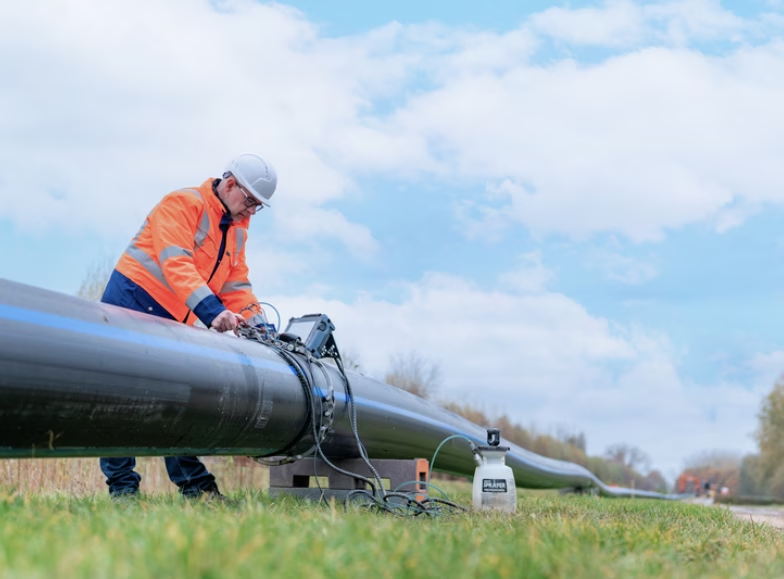
A commonly used method is Time of Flight Diffraction (ToFD). This is an ultrasonic examination technique that uses a scanner to send sound waves through the mirror weld. Our specialist then analyzes the signals to identify any abnormalities in the weld.
The scan results in an image of the inside of the mirror weld. On this, for example, air bubbles or sand grains may be visible. Based on these results, the inspector determines whether there are any possible impermissible deviations.
Expertise of Normec
Normec has experienced welding inspectors and specialized equipment for inspection of plastic welding joints. Our specialists combine on-site inspections with laboratory testing to provide a complete picture of butt weld quality.
For you, this means:
-
1.
Insight into the internal quality of butt welds.
-
2.
Detection of possible deviations such as inclusions
-
3.
Independent assessment of welded joints
-
4.
Support in quality control of the welding process
-
5.
Reduced risk of problems in the piping system
Quality of the welded joint
Non-destructive testing is performed by our welding inspectors in addition to visual examination. With visual examination, the outside of the mirror weld is inspected and assessed. With ultrasonic NDT examination, on the contrary, the inspector can assess the inside of the weld.
In addition, destructive testing can be performed in Normec Testing's laboratory. This involves testing the strength of the butt weld with a tensile test. Whereas NDT leaves the weld intact, destructive testing actually loads the weld to determine the strength.
Combining these examination methods provides a complete picture of the quality of the welded joint.
Want to know more about NDT in butt welding?
Frequently Asked Questions
-
NDT stands for non-destructive testing. Here the quality of a welded joint is examined without damaging the weld.
-
Time of Flight Diffraction (ToFD) is an ultrasonic inspection method used to analyze the inside of a welded joint.
-
Among other things, abnormalities such as air bubbles, inclusions or other irregularities in the weld.
-
With visual examination, the outside of the weld is inspected. With NDT, the inside of the weld can also be examined.
-
In NDT, the weld remains intact. In destructive testing, the weld is loaded in the laboratory, for example with a tensile test.