The European Union Emissions Trading Scheme will enter its most critical phase in 2026. After gradual implementation, the maritime sector will face full compliance, where 100% of CO₂ emissions will be priced and, for the first time, methane (CH₄) and nitrous oxide (N₂O) will be included. This shift will lead to higher costs, stricter reporting requirements and new strategic challenges for both shippers and carriers.
The EU ETS phase-in in 2026: What will change?
Full emissions coverage
From Jan. 1, 2026, shipping companies will be required to submit allowances for 100 percent of their verified carbon equivalent emissions for all voyages involving EU or EEA ports. This marks the end of the phased implementation, which began with 40% coverage in 2024 and 70% in 2025 and 100% in 2026.
What does this mean?
- In 2025, the EU ETS only took into account CO₂ emissions: In previous regulatory frameworks, ships were often allocated in the form of emission trading units (EU Allowances or EUAs) that mainly covered CO₂ emissions from fuel combustion.
- Expansion now includes CO₂ equivalent (CO₂e): The scope of the regulations has now been expanded to include all greenhouse gases measured as carbon dioxide equivalent (CO₂e), such as methane(CH₄) and nitrous oxide (N₂O), for the purposes of emissions accounting and emission allowances. This means that ships must surrender allowances not only for CO₂, but also for total greenhouse gas emissions expressed as CO₂e.
- All GHG emissions count fully toward the ship's compliance obligations.
- Higher compliance costs.
The following calculations are based on burning 1 ton of fuel on an inter-EU voyage.

For the table/presentation below, the EUA price is set at $80.
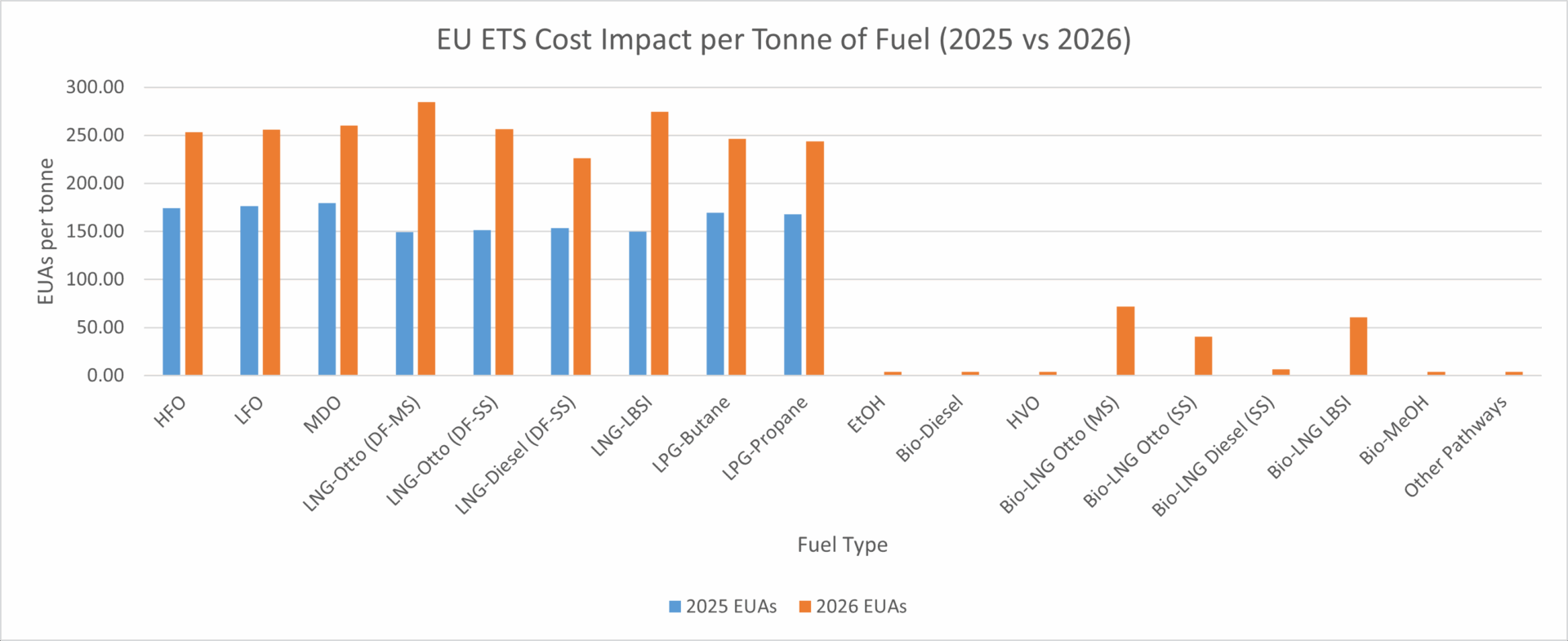
Geographic scope.
The EU ETS applies to:
- 100% of emissions for trips between two EU ports.
- 50% of emissions for trips starting or ending outside the EU.
Including the impact of methane and nitrous oxide
Why it matters
From 2026, the EU ETS will be expanded to include methane (CH₄) and nitrous oxide (N₂O), two potent greenhouse gases:
- Methane has a global warming potential 28 times that of CO₂.
- Nitrous oxide is 265 times more potent than CO₂.
Effects on different types of ships
- Ships using traditional marine fuels (e.g., HFO, LFO, MDO) will also have to account for N₂O emissions, further increasing costs.
- LNG carriers using LNG as fuel will have relatively higher costs because the ship's engines are associated with methane slip.
What is methane slip and why is it important?
Methane slip is the portion of methane in LNG that passes through the engine and auxiliary systems unburned and is released into the exhaust or as operating fluid rather than as CO₂ during combustion. Because methane has a much higher global warming potential than CO₂, even a few percentage points of slip can negate most of the climate benefit of LNG and significantly increase reported CO₂ equivalent emissions. The EU's regulatory framework treats methane slip as a tank-to-wake phenomenon that must be taken into account alongside CO₂ and N₂O when calculating GHG intensity and emission allowance obligations. FuelEU Maritime uses GHG intensity benchmarks for tank-to-wake, while EU MRV and ETS require reporting and, from 2026, surrender of allowances for methane based on defined slip factors.
Standard slip factors for methane today
Until recently, operators had no choice but to rely on default slip factors for methane linked to engine type rather than specific engine performance. For LNG engines, the Commission has proposed default values such as about 3.1% of fuel mass for Otto medium-speed dual-fuel engines and significantly lower values (e.g., about 0.2%) for slow-speed dual-fuel engines, interpolating other technologies based on literature values. These standard coefficients are used in FuelEU Maritime, EU MRV and EU ETS for engines consuming LNG when no certified actual slip factor is available. While easy to apply, they do not take into account modern engine designs and retrofit solutions that can lower the actual methane slip far below the default values, which can lead to over-reporting of emissions and higher compliance costs.
The new EU actual methane slip directive
To fill this gap, the European Commission has issued a special directive for the reporting and verification of actual methane slip emissions from marine diesel engines under FuelEU and the EU MRV/ETS. This document builds on IMO's MEPC.402(83) guidelines for test bed and on-board measurements of methane and nitrous oxide emissions and translates them into a regulatory methodology for deriving annual emission factors.
The approach is conceptually simple: operators perform CH₄ measurements at defined engine loads, develop a load-dependent emission curve in g CH₄/kWh, and combine it with continuously monitored engine load data averaged over 30-minute intervals. Integration of the curve with the recorded load profile over a calendar year provides a verified, engine-specific "actual methane slip factor" that can replace the default slip share in FuelEU and EU MRV/ETS calculations once accepted and verified.
The EU ETS 2026 milestone will bring full emissions coverage, more gases and higher costs, reshaping the maritime industry's approach to compliance and sustainability.
Questions?
Our experts are at your service