



Managing Compliance via METS
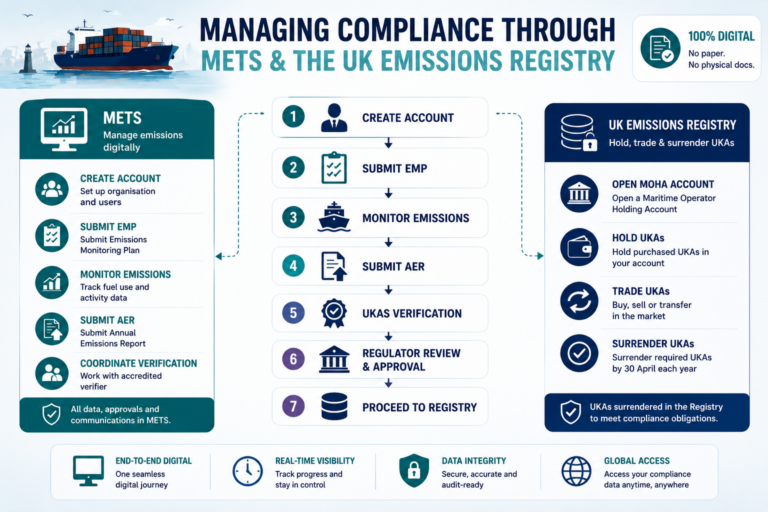
In a significant departure from international maritime traditions, the UK ETS does not issue a physical, paper Document of Compliance (DoC) to be kept on board ships. Instead, a fleet’s entire compliance history is tracked and managed digitally across two unified web platforms:
- METS (Manage the Emissions Trading Scheme): The core digital platform used by operators to create organizational accounts, submit emissions monitoring plans, coordinate with third-party verifiers, and submit verified data.
- The UK Emissions Registry: The secondary transactional portal where companies open a mandatory Maritime Operator Holding Account (MOHA) to store, trade, and execute the final annual surrender of carbon allowances.
Structural Mapping of Assigned Regulators
Shipping companies cannot select their regulator. Every operator is assigned a specific competent UK national authority based on corporate geography:
- Operators with a Registered UK Address: Assigned directly to the national regulator of the territory where their office is located (England, Scotland, Wales, or Northern Ireland).
- International Operators (No UK Address): Default automatically to the Environment Agency (EA) in England.
Regulatory Contact & Communications Matrix
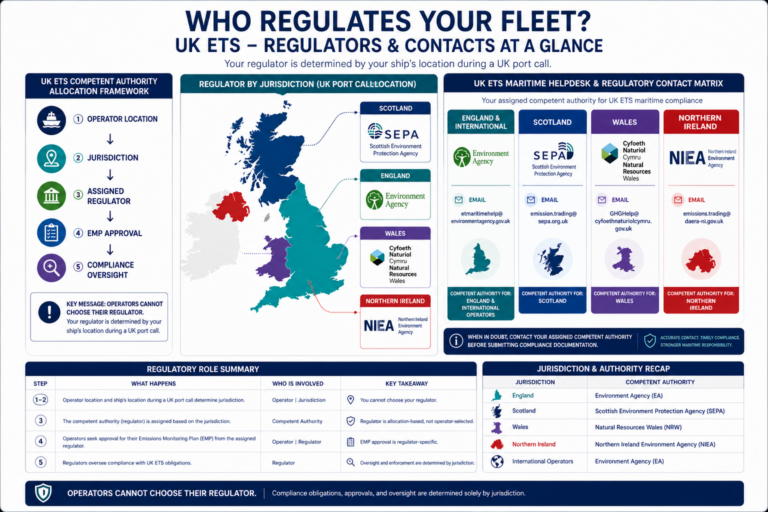
Operators must use these official channels to execute account setups and manage monitoring plan approvals:
| National Jurisdiction | Competent Regulatory Authority | Official Maritime Helpdesk Email |
|---|---|---|
| England & International | Environment Agency (EA) | etmaritimehelp@environmentagency.gov.uk |
| Scotland | Scottish Environment Protection Agency (SEPA) | emission.trading@sepa.org.uk |
| Wales | Natural Resources Wales (NRW) | GHGHelp@cyfoethnaturiolcymru.gov.uk |
| Northern Ireland | Northern Ireland Environment Agency (NIEA) | emissions.trading@daera-ni.gov.uk |
Understanding the ‘Double-Surrender’ Period
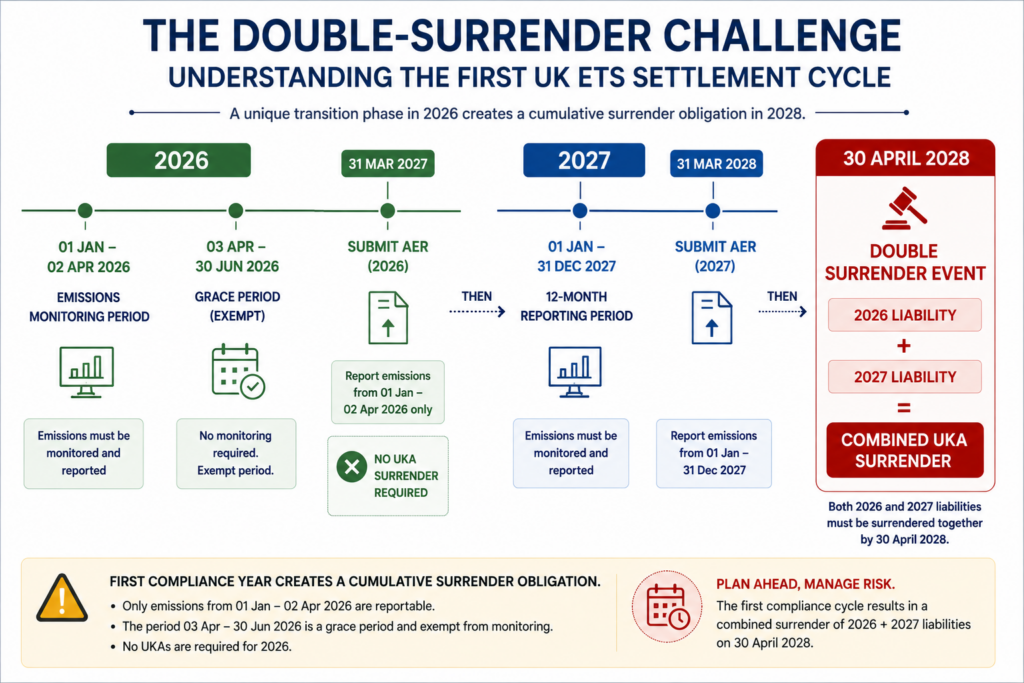
To avoid non-compliance, maritime operators must transition into a rigorous corporate data management cycle.
To protect operators from immediate cash flow strains while onboarding, the UK Authority has decoupled the first annual data reporting deadlines from the actual allowance surrender deadlines:
- 2026 Reporting Deadline: The verified 6-month AER for 1 July – 31 December, 2026 must be submitted via METS by 31 March 2027. No allowances are turned over to the state currently.
- 2027 Reporting Deadline: Verified 12-month AER must be submitted via METS by 31 March 2028.
- The First Joint Allowance Surrender: On 30 April 2028, operators face a combined “double-surrender” deadline. Companies must simultaneously surrender United Kingdom Allowances (UKAs) into the registry to cover their emissions liabilities for both the 2026 partial period and the full 2027 calendar year.
Financial Compliance – Sourcing Market Allowances
Operating within the UK ETS transforms carbon emissions into a direct, volatile corporate balance-sheet liability.
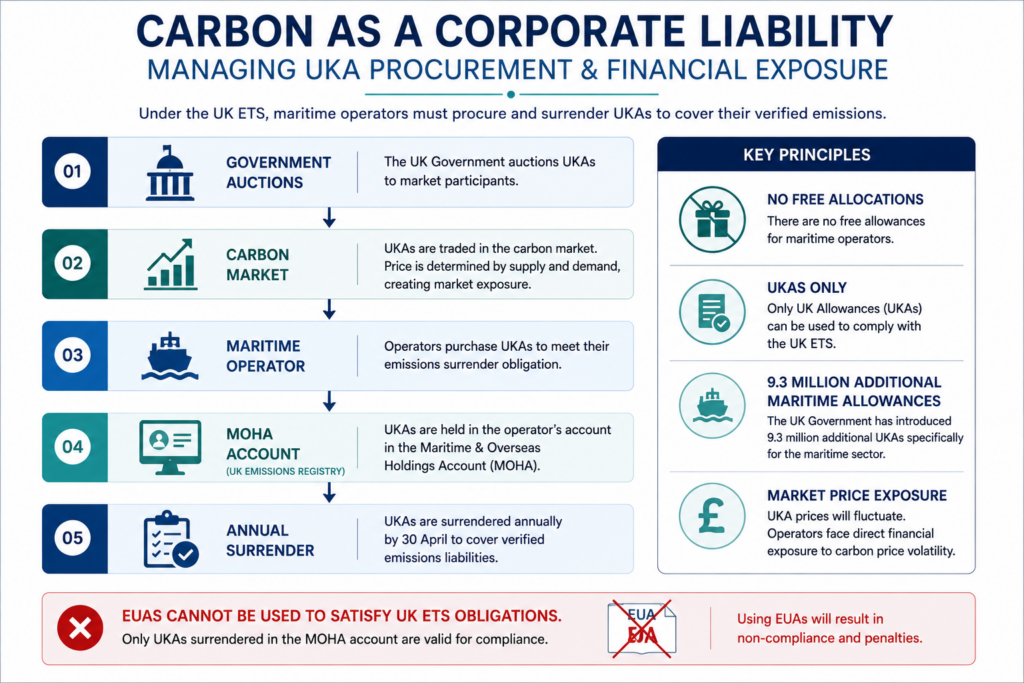
To integrate the shipping sector, the UK Government is injecting 9323546 total allowances into the general UK ETS cap for Phase I (running through 2030). This volume is strictly aligned with the UK’s Maritime Decarbonisation Strategy net-zero pathway.
- Zero Free Allocations: Unlike traditional manufacturing or aviation, the maritime sector receives no free carbon allocations. 100% of the maritime cap adjustment flows directly into state auctions.
- Sourcing Units: Operators must secure United Kingdom Allowances (UKAs) directly through official government auctions or open secondary carbon trading markets.
Strict Market Separation Warning: Operators cannot surrender EU Allowances (EUAs) to cover a UK ETS debt. Sourcing an EUA for a British compliance obligation is legally invalid and will leave the company fully exposed to structural non-compliance penalties.
The Non-Compliance Penalty
Compliance with the UK Emissions Trading Scheme (UK ETS) is not limited to monitoring and reporting emissions. Operators must also surrender the required number of UK Allowances (UKAs) corresponding to their verified emissions. Failure to do so can result in significant financial penalties and ongoing compliance obligations. The penalties for failing to purchase and surrender sufficient UKAs by the annual 30 April deadline are immediate and severe:
- The Excess Emissions Penalty: A fixed civil penalty of £100 for every single tonne of carbon dioxide equivalent (CO2e) emitted which as not covered – for which no allowance was surrendered. Following identification of the non-compliance, the Competent Authority will issue a formal penalty notice to the responsible operator.
- The Repayment Mandate: Paying the £100 per tonne penalty does not cancel the original compliance debt. A common misconception is that payment of the civil penalty resolves the compliance issue. This is not the case –
Even after the penalty has been paid:
- The underlying compliance obligation remains.
- The emissions shortfall is still outstanding.
- The operator must still surrender the missing UKAs covering those emissions. The operator remains legally obligated to purchase and surrender the missing allowances during the subsequent calendar cycle, compounding their market exposure.
Potential Consequences Beyond Financial Penalties
Failure to comply with UK ETS obligations may lead to consequences beyond the direct monetary penalty, including:
- Increased regulatory scrutiny and enforcement action.
- Escalation of compliance measures by the authorities.
- Reputational damage with customers, charterers, financiers and other stakeholders.
Operators should therefore view allowance surrender as a core compliance requirement rather than simply a financial obligation.
Allocation of Responsibilities Between Owners and Charterers
Given the commercial impact of UK ETS compliance, shipowners and charterers should clearly define:
- Which party is responsible for procuring UKAs.
- How carbon costs will be calculated and reimbursed.
- Responsibility for penalties arising from non-compliance.
- Procedures for emissions data sharing and settlement of carbon costs.
Clear contractual arrangements help minimise disputes and provide certainty regarding financial responsibility.
Role of BIMCO Clauses
Industry-standard clauses developed by BIMCO can assist parties in allocating UK ETS-related responsibilities and costs.
These clauses can address matters such as:
- UKA procurement obligations.
- Carbon cost reimbursement mechanisms.
- Allocation of liabilities and penalties.
- Information-sharing requirements between parties.
The use of well-drafted contractual provisions can significantly reduce the risk of disagreements and unexpected financial exposure.
Commercial Cost Recovery: Pass-Through Clauses
Unlike initial industry proposals, the UK Government has firmly stated it will not provide a legislative mandate for cost recovery or carbon cost pass-through to time-charterers. The state expects commercial parties to resolve carbon asset positioning through standard contract law.
Because operational decisions (speed, route, and cargo) are typically determined by commercial charterers, ship managers and owners must proactively integrate standardized carbon clauses such as BIMCO ETS allocation clauses directly into charter party agreements to ensure seamless commercial pass-through.
Want to create a safe and healthy working and living environment?
We test, inspect and certify so organizations can innovate safely, quickly, efficiently and cost-effectively.
Related Services


Related Articles


15 Jul 2026
Smooth Sailing: Building Stronger Communication with Suppliers and Clients
In today’s fast-moving, compliance-driven world, communication is far more than a routine task; it is the bridge that keeps operations running smoothly. Whether collecting critical documents such as Material Declarations (MD), Suppliers’ Declarations of Conformity (SDoC), or IHM-related reports, the quality and consistency of communication often determine how efficiently everything gets done.


15 Jul 2026
Strategic Asset Lifecycle Management Under the Hong Kong Convention: The Critical Imperative of Early IHM Preparation and Recycling Readiness
As the global ship recycling industry moves toward stricter compliance under the Hong Kong International Convention for the Safe and Environmentally Sound Recycling of Ships (HKC), the importance of proactive compliance planning for Inventory of Hazardous Materials (IHM) Part I, Part II, and Part III has increased significantly across the maritime sector. The recent implementation of IMO Resolution MEPC.379(80), introducing the 2023 Guidelines for the Development of the Inventory of Hazardous Materials, together with the latest amendments adopted under MEPC.405(83) in April 2025, has further strengthened industry expectations regarding hazardous material identification, documentation accuracy, and recycling preparedness.


13 Jul 2026
SBTi corporate Net-Zero standard V2.0: What changes and what it means for your business
The Science Based Targets initiative published Version 2.0 of its Corporate Net-Zero Standard on June 11, 2026, effective February 1, 2027. Used by more than 11,000 companies globally, the standard has been fundamentally rewritten. Here is what practitioners need to know.


10 Jul 2026
The EU Commission Adopts EFRAG’s Revised Sustainability Reporting Standards for ESRS: What It Means for Your CSRD Reporting
On 3 July 2026, the European Commission formally adopted the Delegated Act containing the revised (simplified) European Sustainability Reporting Standards (ESRS), the detailed reporting framework for companies subject to the Corporate Sustainability Reporting Directive (CSRD). The adoption follows EFRAG’s final technical advice, submitted on 3 December 2025, and a public consultation on the Commission’s draft in May–June 2026. A separate Delegated Act establishing a voluntary sustainability reporting standard for undertakings outside the CSRD’s scope was adopted at the same time.


10 Jul 2026
SAF and RTFO: The Certificate Is Only as Good as What's Behind It
RTFO and the SAF Mandate are the UK’s two principal schemes for reducing transport fuel emissions.¹ - RTFO covers road transport, non-road mobile machinery and certain maritime renewable fuels. - The SAF Mandate covers aviation, requiring SAF to reach 2% of UK jet fuel demand from 2025, rising to 10% by 2030 and 22% by 2040.² Suppliers prove compliance with certificates tied to qualifying fuel or pay a buy-out price for any shortfall. Both schemes work the same way: a supplier makes a sustainability claim, earns a certificate, and trades or redeems it against a target. Simple in theory—but only as solid as the claim behind it.


09 Jul 2026
India's carbon market enters its compliance era: What 490 obligated entities now face
As countries around the world strengthen climate policies to meet their Paris Agreement commitments, carbon markets have emerged as one of the most effective tools for reducing greenhouse gas (GHG) emissions. Recognizing this, India has established the Carbon Credit Trading Scheme (CCTS) the foundation of the Indian Carbon Market (ICM) under the Energy Conservation (Amendment) Act, 2022, with the scheme formally notified in June 2023.


09 Jul 2026
Beyond compliance: Is your market instrument ready?
As outlined in the accompanying article, the SBTi Corporate Net-Zero Standard Version 2.0 takes a more structured approach to market instruments and sets clearer conditions for how they may support decarbonisation. The more practical question for companies is what this means for programme design, evidence, and claims.