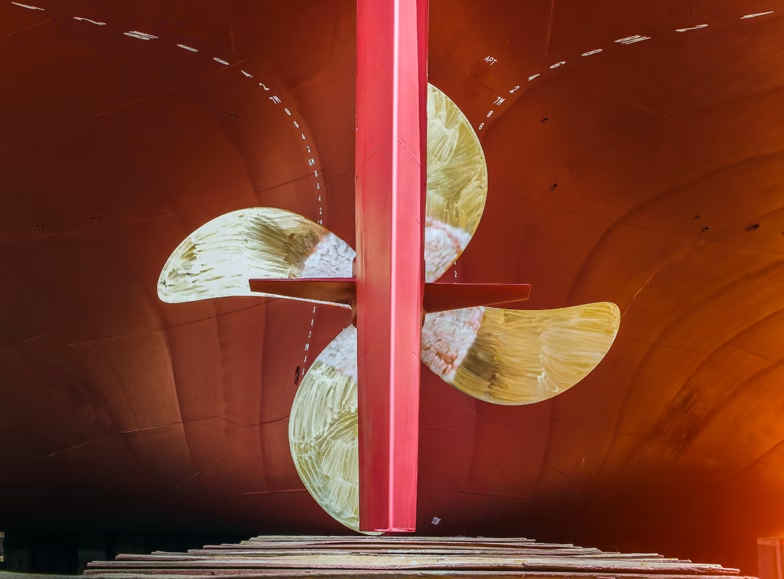


For accurate vessel performance and EEXI compliance
Computational Fluid Dynamics (CFD) plays an important role in the maritime sector. CFD analysis allows us to make accurate speed–power predictions for vessels.
At Normec Verifavia, we use CFD to determine the actual reference speed of a vessel. This speed is an important parameter when calculating the Energy Efficiency Existing Ship Index (EEXI).
By using CFD simulations, we can not only comply with regulations but also evaluate the impact of Energy Saving Devices (ESDs) for retrofit projects. This provides insight into your vessel’s performance and allows you to make better-informed decisions regarding energy efficiency and compliance.

Powerful and cost-efficient
CFD is a branch of fluid dynamics in which complex flow problems are solved using powerful computers and 3D models.
The calculations are based on well-known physical models such as:
- The Navier–Stokes equations
- The Reynolds-Averaged Navier–Stokes (RANS) equations for turbulent flows
CFD is widely used in industries such as aerospace, oil & gas, automotive, and shipping. Within the maritime sector, CFD is often used during the concept and design phase of vessels to determine speed–power curves. Compared to traditional towing tank tests, CFD is a powerful and cost-efficient tool.
EEXI calculations and energy saving
One of the most important factors influencing the attained EEXI is the vessel’s reference speed (Vref). This is the vessel speed at 75% MCR under the EEXI draft condition and is normally determined based on sea trial reports.
In practice, however, situations often arise where these data are not available:
- Sea trials are usually performed at ballast draft for bulk carriers and container ships
- EEXI calculations require different conditions, such as summer load line or 70% deadweight
When the required speed–power curve is missing, Vref is calculated using a formula from the EEXI Calculation Guidelines (MEPC 333(76)). This method is based on statistical ship data and includes a safety margin of 5% speed reduction. This often leads to a less favourable EEXI score.
An alternative is determining Vref through numerical calculations such as CFD. By calibrating CFD results with existing sea trial data, a more accurate and often more favourable EEXI result can be achieved. In addition, CFD simulations can be used to predict speed–power curves for modifications involving Energy Saving Devices (ESDs).
Examples include:
- Propeller ducts
- Modified bulbous bows
These modifications influence vessel propulsion and must be supported with sea trials, towing tank tests, or CFD reports for use in EEXI calculations.
Expertise in CFD modelling
Normec Verifavia combines maritime expertise with advanced simulation technology. Our specialists analyse the hydrodynamic performance of vessels using accurate digital models.
With our experience in EEXI calculations, retrofit projects, and energy efficiency, we can translate CFD results directly into practical insights for your fleet.
What does CFD mean for you in practice?
- You obtain more accurate speed–power calculations for your vessel
- You can optimise EEXI scores with realistic reference speeds
- You reduce costs by minimising physical tests or sea trials
- You can analyse the impact of Energy Saving Devices in advance
- You make better-informed retrofit and efficiency decisions

Prepared for future emissions and efficiency regulations
International shipping is under increasing pressure to reduce emissions and improve energy efficiency. CFD analysis helps you prepare for current and future regulations.
By analysing performance digitally, you can respond more quickly to new requirements and make strategic decisions regarding retrofit, optimisation, and compliance.
Would you like to learn more about CFD analysis?
Downloads
You might also be interested in these services








Frequently asked questions about computational fluid dynamics (CFD)
-
Computational Fluid Dynamics (CFD) is a simulation method used to digitally calculate the flow of fluids around objects, such as vessels, using advanced computers and 3D models.
-
CFD helps analyze the hydrodynamic performance of ships. It allows accurate calculation of speed-power curves, drag and energy efficiency.
-
CFD can be used to accurately determine the reference speed (Vref) of a vessel. This can lead to a more realistic and sometimes more favorable EEXI result compared to calculations based on statistical formulas.
-
In many cases, CFD can be a cost-effective alternative to traditional drag tank testing or additional test runs. Digital simulations allow for rapid analysis without physical testing facilities.
-
Yes. CFD simulations can predict the impact of energy-saving devices (ESDs), such as propeller shafts or custom bulb arcs, and support EEXI calculations.
-
The length of time depends on the complexity of the vessel and the available data. In many cases, results can be obtained faster than with traditional testing methods.
-
Computational Fluid Dynamics (CFD) uses advanced computer simulations to analyze fluid flows around objects such as ships.
For EEXI calculations, CFD is used to accurately determine the vessel's reference velocity (Vref). This velocity is essential for calculating EEXI.With CFD, you avoid overestimating the required engine power (EPL) due to approximations of formulas in the regulations. As a result, you can often achieve a more realistic and favorable EEXI result.