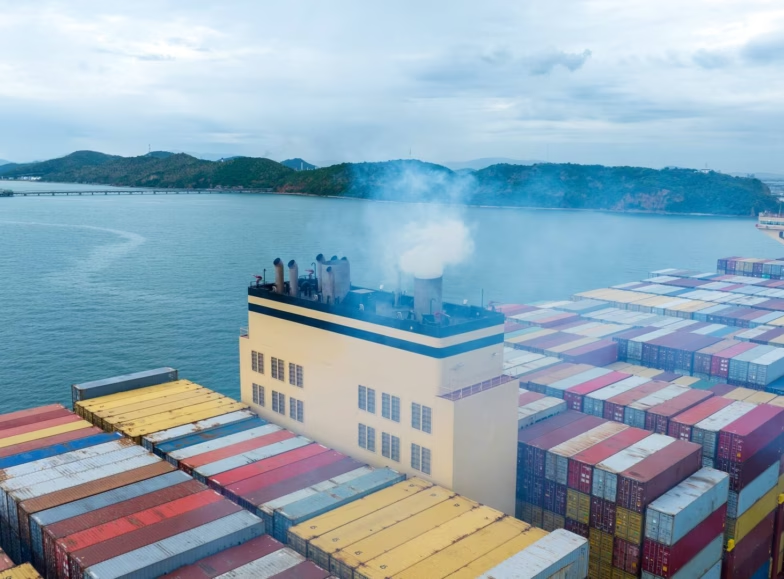


IMO DCS Verification for shipping emissions
The IMO Data Collection System (DCS) is a global system of the International Maritime Organization (IMO) for monitoring and reporting fuel consumption of ships. The system is mandatory under MARPOL Annex VI, Regulation 27 and aims to monitor and reduce greenhouse gas (GHG) emissions from international shipping.
The IMO DCS requires shipowners to collect annual data on fuel consumption and operational performance of their vessels. This information contributes to better insight into energy efficiency and supports international efforts to reduce emissions in the maritime sector.
The system applies to:
- Ships of 5,000 GT or larger
- Ships engaged in international voyages
- All ship types, including cargo ships, passenger ships and offshore vessels
The regulation is based on:
- MARPOL Annex VI, Regulation 27
- MEPC.346(78) and MEPC.395(82) – updated guidelines
New reporting requirements according to MEPC.395(82)
The recent amendments in MEPC.395(82) introduce additional reporting elements to analyse ship energy use more accurately.
New reporting requirements include, among others:
Fuel consumption per combustion system
Fuel consumption must be reported separately for:
- Main engines
- Auxiliary engines and generators
- Oil-fired boilers
Fuel consumption when the ship is not underway
Fuel consumption during periods when the ship is at anchor or alongside must be recorded separately.
Distance travelled including laden distance
Operators are encouraged to also report laden distance, which helps analyse operational efficiency.
Transport work
Transport work is calculated using the formula:
Transport Work = Cargo Weight × Distance
This indicator helps compare energy efficiency between different ships.
Use of shore power
Ships must report how much shore power (onshore power) is used when the ship is in port. This helps monitor the use of more energy-efficient solutions.
Our approach
Normec Verifavia supports shipowners in correctly monitoring and reporting fuel consumption and emission data according to IMO guidelines.
Our services include, among others:
- Assessment of fuel consumption data and operational data
- Verification of reports according to SEEMP Part II
- Checking completeness, accuracy and consistency of data
- Verification according to IMO guidelines and MEPC resolutions
Normec Verifavia is accredited under ISO 17029 and recognized by multiple flag states to perform independent verifications.
Normec Verifavia's expertise
Normec Verifavia is an independent verification body with extensive experience in maritime emission regulations.
We support shipowners worldwide with compliance including:
- IMO DCS
- SEEMP Part II and III
- EU MRV
- EU ETS
- FuelEU Maritime
- CII requirements
Thanks to our international accreditations and delegations from various flag states, we can provide reliable and efficient verification services.
Independent verification helps shipowners report transparently and remain compliant.
What this delivers for you in practice:
- You comply with IMO regulations under MARPOL Annex VI
- You minimize compliance risks and potential penalties
- You obtain reliable emission data for energy efficiency analysis
- You improve transparency towards regulators and stakeholders
- You support the sustainability of international shipping
Downloads
- MEPC.328(76) – 2021 Revised MARPOL Annex VI
- Resolution MEPC.346(78) – 2022 Guidelines for the development of a Ship Energy Efficiency
- Resolution MEPC.348(78) – 2022 Guidelines for administration verification of ship fuel oil consumption data and operational carbon intensity
- MEPC.349(78) – 2022 Guidelines for the development and management of the IMO ship fuel oil consumption database
Would you like to know more about IMO DCS Verification?
You might also be interested in these services


Frequently asked questions about the IMO Data Collection System (DCS) Verification
-
The system applies to ships of 5,000 GT or larger engaged in international voyages.
-
Operators must report, among other things:
- Fuel consumption per fuel type
- Distance travelled
- Hours underway
- Energy consumption onboard
-
SEEMP Part II (Ship Energy Efficiency Management Plan) describes how fuel consumption is monitored and reported under the IMO DCS system.
-
A Statement of Compliance (SOC) confirms that the fuel consumption report has been verified and complies with IMO DCS regulations.
-
The annual fuel consumption report must be verified and submitted by 31 May at the latest to the flag state, which then forwards the data to the IMO GISIS database.
-
For monitoring fuel consumption under IMO DCS, three methods are allowed:
Method 1: Bunker Delivery Notes (BDN) - using bunker delivery documents to calculate fuel consumption.
Method 2: Flowmeters - direct measurement of fuel consumption via fuel flow meters.
Method 3: Monitoring onboard bunker tanks - calculation of consumption based on fuel tank level measurements.
The chosen method must be documented in SEEMP Part II and applied consistently.
-
Each year, a ship must have a Statement of Compliance (SoC) onboard by 31 May for the fuel consumption of the previous calendar year.
This statement is issued by the flag state, classification society or a recognized organization (RO) after verification of the data.
-
When a ship changes management during a calendar year, the following responsibilities apply:
- The current (departing) management organization is responsible for collecting and reporting data up to the time of transfer.
- This data is verified by an approved verifier, after which a partial Statement of Compliance (SoC) is issued by the flag state or recognized organization.
After transfer:
- The new management organization must collect all transfer documents, including the partial SoC.
- The new management organization becomes responsible for further data collection and reporting until the end of the year.
- An accredited verifier must be appointed to verify the remaining period.
-
The Carbon Intensity Indicator (CII) is calculated based on the ship's data for an entire year, from January 1 to December 31, regardless of any management changes during the year.
-
If a ship receives a CII rating of E, the new management organization is responsible for updating SEEMP Part III, including preparing a Corrective Action Plan (CAP).
-
Non-compliance with IMO DCS requirements can have different consequences depending on the flag state or port authority. Possible sanctions include:
- Fines or financial penalties
- Detention of the ship in port
- Reputational damage to the shipping company
Timely and correct verification of emission data helps avoid these risks.