

New SNA standard (NEN 4400-1) as of February 13, 2023
On January 9, we immediately started the new year with a technical consultation to dot the i's on the approaching revised NEN 4400-1 standard. Earlier we informed you about the main changes of this revised standard. The new standard has now been published and as of February 13, 2023 our inspectors will actually test according to this new standard.
In this article I would like to take you through the main changes of this revised standard in more detail and prepare you for what you can expect in the coming inspections. That way, not only are we ready, but so are you!
By: Julisa Fereijra - Phelipa, Business Unit Director Normec VRO
Objective of the revised standard
The standard NEN4400-1:2023 together with the SNA Handbook of Standards forms the SNA scheme. The main objective of this revision is to arrive at a more risk-oriented approach. Among other things, this means that we no longer routinely conduct a full inspection annually, followed by a shortened inspection after six months. In the revision, the full inspection serves as a baseline measurement. This baseline measurement always determines what the follow-up inspection will look like. The content of a follow-up inspection depends on the extent to which a company has its records in order and on any risk areas that need to be zoomed in on. In this way, inspectors can focus a follow-up inspection on matters relevant to your company.
Follow-up inspection
The follow-up inspection has four variants. You qualify for the lightest variant (only testing on the General module) if no non-conformities have been found. In addition, all relevant written and/or automated procedures are present and working.
The operation is demonstrated by not having non-conformities. In the table you can see which parts of the standard the general module contains and what you are tested for.
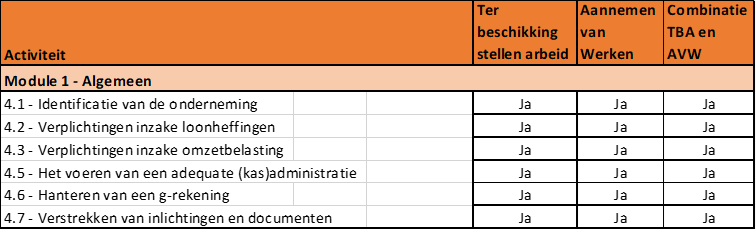
Standard Requirements
The standard is currently divided into the modules General, Temporary Employment (TBA) and Acceptance of Work (AvW), with the corresponding standard requirements in each module. The hiring and on-lending of personnel and self-employed workers is also still covered in the relevant modules. In terms of content, little changes. So organizations that currently meet the current standard requirements are expected to do so in the revised standard. Companies doing both TBA and hiring work will be labeled as "mixing companies" in the revised standard and must be tested on both modules. The tables below show which parts of the standard you will be tested on for each module.
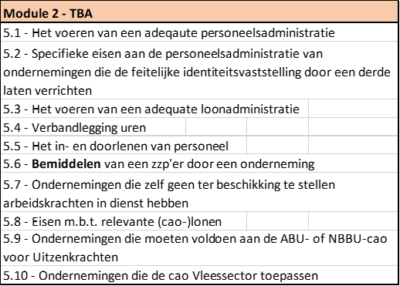
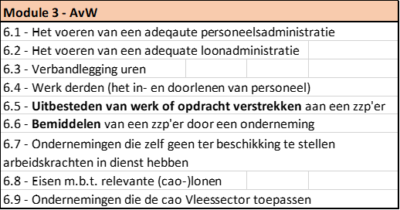
Procedures
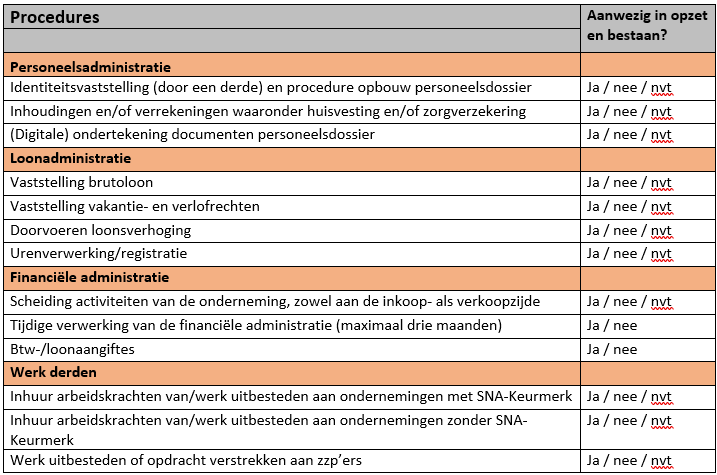
The revised standard is more risk-oriented. The presence of procedures and their operation are now part of the standard. We therefore include these procedures in our inspections. The procedures must be present in written or automated form.
If a company can demonstrate that all relevant procedures are present, the inspection and spot checks must then show that they are working. If non-conformities are found, then the inspector must conclude that the procedure is not (fully) working and therefore not (fully) present. In that case, the company is no longer eligible for a follow-up inspection of the lightest variety.
Risk analysis
As mentioned earlier, the revised standard is risk-oriented. Of course, this includes a new risk analysis. This new risk analysis only shows whether the company falls into a high or low risk category. The company falls into a high risk profile if 6 or more of the following questions are answered with "yes".
- Are the employees employed on a TBA AND contracting basis (mixed companies)?
NOTE If this is not apparent, the inspector will assume a mixed company. - Is there a turnover of 20% or more in the workforce? (Balance in and out of service based on collective wage statement.)
- Is the gross wage at or at most 15% above the WML?
- Are deductions made from wages in connection with housing?
- Are deductions made from wages in the context of health insurance?
- Is the ET regulation applied to at least one employee?
- Are employees employed who are nationals of a member state outside the European Union, or the European Economic Area, or Switzerland?
- Are the clients employed in one or more of the following sectors: Agriculture & Horticulture, Metal & Industry, Hospitality, Retail, Cleaning, Construction, Rail, Meat, Transportation?
- Is there any initial inspection?
- Has the company been established within the past six months or has the company only become active as a temp and/or work contractor within the past six months?
- Are time records and payroll records maintained through unconnected systems? (Intervention/adjustment is then possible).
The results of this risk analysis determine the sample size of the personnel file and line checks.
Sample
If there is a low risk profile, a sample of 10 is drawn. In the case of a high risk profile, there are 15. The distribution of these numbers is as follows:
Number of samples 10:
- 2 pay slips with payment of reserves on leaving employment
- 2 payslips showing payment of vacation allowance
- 2 payslips with payment of holidays
- 4 regular pay slips (evenly distributed over the inspection period).
Number of samples 15:
- 3 pay slips with payment of reserves on leaving employment
- 3 payslips with payment of vacation allowance
- 3 pay slips with payment of holidays
- 6 regular pay slips (evenly distributed over the inspection period).
Weighting non-conformities and demonstrating repair
The weighting of non-conformities has changed. Whereas previously, when one or more errors were found in the sample, an expansion of the original sample had to take place, this is abandoned in the revised standard. The sample numbers in the revised standard are statistically based such that one error in the sample says something about the total population. The premise here is that the repetition of a specific error in the sample results in this specific error being valued as structural.
This does imply that with a single error in the sample, this error results in the recording of a nonconformity that must be repaired within 3 months using the 4-O system. In our free white paper you can read more about recovery based on the 4-O system.
If there are two or more errors in the sample on the same standard element, identified as major non-conformities in the 'old' standard, this will lead to a major non-conformity in the revised standard.
What does this mean for my inspection?
All full inspections scheduled as of Feb. 13 will be tested against the revised standard. Thus, a follow-up inspection will follow from these full inspections and no longer an abbreviated inspection.
A transition period applies to all abbreviated inspections taking place from February 13. These inspections will still be tested on the 'old' standard NEN 4400-1:2017, but will already be reported and processed according to the revised standard NEN 4400-1:2023. To determine the sample, the risk analysis of the revised standard NEN 4400-1: 2023, will be used. This will be followed by a full inspection and then a follow-up inspection.
Need help with certification in your industry?
Contact our specialist