

The changes follow the structure and approach of NEN 4400-1:2023 and include:
- a modular structure of the standard;
- a new inspection system with an annual baseline measurement and follow-up inspections tailored to it;
- a risk-oriented approach, with well-performing companies being inspected less intensively.
The revised standard is available via the NEN: NEN 4400-2:2025 nl. In this article, we list the most important changes and provide insight into what you can expect during inspections. This way, together we ensure that you are well prepared.
Purpose of the revision
The NEN4400-2:2025 standard together with the SNA Handbook of Standards form the SNA scheme. The main purpose of the revision is a more risk-oriented approach to inspections. There is no longer a standard full inspection with an abbreviated inspection after six months. From now on, the full inspection functions as a zero measurement. Based on this baseline measurement, it is determined what the follow-up inspection will look like. The extent to which a company has its records in order and any risk areas determine the content of the follow-up inspection. In this way, inspectors can focus a follow-up inspection on matters relevant to your company.
Follow-up inspection
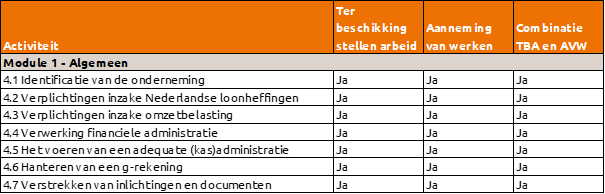
Depending on the results of the baseline measurement, there are four variants of follow-up inspections. The lightest variant, inspection of only the 'General' module, is possible if:
- no non-conformities have been identified;
- all relevant procedures are present in written or automated form;
- the inspection shows that these procedures are actually working. Operation is shown by not having non-conformities.
The table shows which standard components the General module contains and therefore what you are tested for.
What changes?
Standard requirements
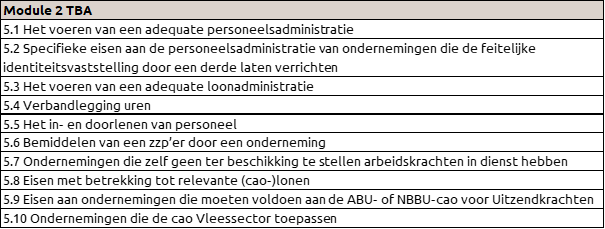
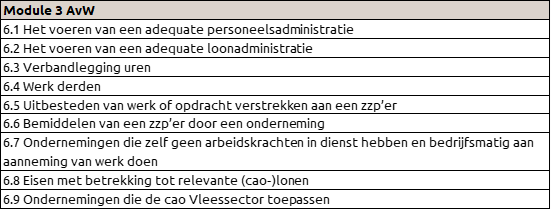
The standard is divided into three modules:
- General
- Placing of Labor (TBA)
- Taking on Work (AvW)
The hiring and on-lending of staff and self-employed workers remains part of the relevant modules. Companies that both provide temporary employment (TBA) and take on work are considered to be mixed companies. For them, testing applies to both modules. The substantive requirements remain largely the same, so organizations that comply now are also expected to meet the revised standard. The tables below show which standard components you will be tested on for each module.
Procedures
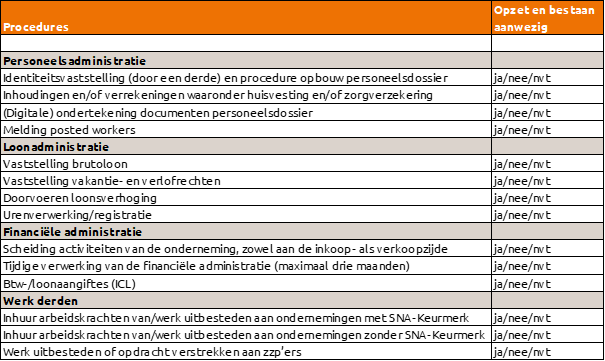
The presence and operation of procedures are explicitly part of the standard. We therefore include these in our inspections. Procedures must be demonstrably present - in writing or computerized - and effectively demonstrated by inspections and spot checks. If non-conformities are found, the inspector must conclude that the procedure is not (fully) working and is therefore not (fully) present. In that case, the company is no longer eligible for a follow-up inspection of the lightest variety.
Risk analysis
The revised standard introduces a new risk analysis. This new risk analysis only shows whether the company falls into a high or low risk profile. A company falls into the high risk profile if 6 or more of the following questions are answered with "yes."
- Is there both TBA and AvW (mixed company).
> If this is not transparent, the inspector will assume a mixed company. - Is there a staff turnover of 20% or more? (Balance in and out of service based on collective wage statement)
- Is the gross wage at or up to 15% above the WML?
- Are there deductions from wages for housing?
- Are there deductions from wages for health insurance?
- Is the ET regulation applied?
- Are workers employed from outside the EU/EEA/Switzerland?
- Are clients active in any of the following sectors: Agriculture & Horticulture, Metal & Industry, Hospitality, Retail, Cleaning, Construction, Rail, Meat, Transportation?
- Is there any initial inspection?
- Has the company been established within the past six months or has the company only become active as a temp and/or work contractor within the past six months?
- Are A1 secondment certificates applied?
The outcome of this risk analysis determines the sample size of personnel files and line checks.
Sample
For a low risk profile, the sample size is 10. For a high risk profile, it is 15. The distribution of these numbers is as follows:
Number of samples 10:
- 2 pay slips with payment of reserves on leaving employment
- 2 payslips showing payment of vacation allowance
- 2 payslips with payment of holidays
- 4 regular pay slips (evenly distributed over the inspection period).
Number of samples 15:
- 3 pay slips with payment of reserves on leaving employment
- 3 payslips with payment of vacation allowance
- 3 pay slips with payment of holidays
- 6 regular pay slips (evenly distributed over the inspection period).
Non-conformities and recovery
The weighting of non-conformities has been adjusted. Whereas previously an expansion of the sample was required when one or more errors were found in the sample, this has been abandoned in the revised standard. The new sample numbers are statistically based and representative of the total population. Thus, one error in the sample may already be sufficient to draw conclusions about the completeness and reliability of the records.
The basic assumption is that repetition of the same error within the sample indicates a structural problem. In that case, the error is assessed as structural and recorded as a nonconformity, which must be repaired within three months according to the 4-O system. Two or more errors on the same standard element, which were classified as major non-conformities in the "old" standard, lead to a major non-conformity.
Read more about the 4-O systematics in our free white paper.
What does this mean for your inspection?
Starting Jan. 1, 2026, all full inspections will be performed according to the revised standard. A follow-up inspection follows from these full inspections, not an abbreviated inspection.
Abbreviated inspections taking place from January 1 have a transition period: they are still tested against the old standard (NEN 4400-2:2017), but reported and processed according to the new standard. The risk analysis of the revised standard is already applied in determining the sample.
Ready for the new standard?
Do you have questions or want to spar about the impact of the new standard on your organization? Please contact us. We are happy to think along with you.