



Accessibility links Skip to main content

EU carbon removals framework advances toward certified purchases

Established by Regulation (EU) 2024/3012 and in force since 6 December 2024, the EU Carbon Removals and Carbon Farming (CRCF) framework provides a voluntary certification system for permanent carbon removals, carbon farming and carbon storage in products. It introduces common quality criteria, monitoring and reporting requirements, and independent verification to strengthen confidence in certified outcomes and support investment. In 2026, implementation has advanced through new methodologies, assessments of certification schemes, and preparations for the Buyers Club’s first purchases.

Continue reading
Glass globe with a sustainability icon on Earth against a green, natural background

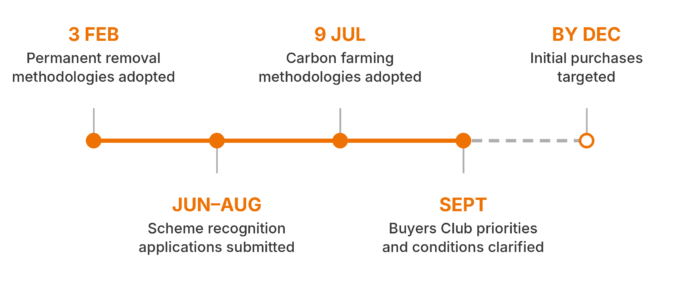
The 2026 implementation timeline

https://files.normecgroup.com/images/Certification/Certification-Companies/Normec-Verifavia/timeline_2026-680x281.png
Figure 1: Selected milestones in 2026. Schematic timeline; the dashed segment denotes a future target.

September brings clearer conditions for the first deals

The September Buyers Club bulletin describes a working group formed by prospective buyers to share non-confidential project information and prepare potential transactions. Initial purchases will focus on permanent removals covered by CRCF methodologies, particularly biogenic emissions capture with carbon storage (BioCCS). The Commission convenes the initiative, while participating buyers retain responsibility for due diligence, purchasing and contractual decisions. [1, 2]

The bulletin also establishes a clear prerequisite: a project must be certified through a CRCF-recognised scheme before a Buyers Club purchase is announced. The Commission aims to support initial permanent-removal purchases by December 2026 and longer-term offtake agreements that give projects sufficient revenue certainty to reach a final investment decision. The December date remains a target; it does not establish that transactions have been completed. [1, 2]

For developers, the practical opportunity is to bring project readiness, certification and buyer engagement together. For purchasers, the next decisions concern the specific project, contractual terms and evidence supporting the proposed certified outcome. This is an implication of the initiative’s published purchasing model. [1, 2]

Certification schemes move through technical assessment

The Commission’s published list records eight applications submitted between June and August 2026, including our partners, Isometric, Rainbow, Puro Earth and Oncra, with technical assessments shown as in progress. Formal recognition follows an assessment against the applicable methodologies and governance requirements. Schemes must provide for regular audits by accredited or recognised certification bodies and maintain reliable registries that support traceability and prevent double counting. [3]

New methodologies extend the routes to certification

On 9 July, the Commission adopted carbon-farming methodologies covering agriculture and agroforestry on mineral soils, rewetting and restoration of peatlands and other organic soils, and afforestation. The rules are intended to make certification consistent across the EU and support financial rewards for farmers and land managers. The announcement makes scheme applications conditional on the delegated regulation entering into force. [4]

For permanent removals, Delegated Regulation (EU) 2026/285 covers direct air capture with carbon storage (DACCS), BioCCS and biochar carbon removal. The methodologies adopted on 3 February address the quantification of removals, storage durability, leakage and liability. Together, these requirements provide the technical basis for assessing the pathways prioritised in the initial Buyers Club pipeline. [1, 5, 6]

The next milestones will determine market readiness

Formal scheme recognition, project certification and purchase announcements are the next developments to track. Each establishes something different: recognition confirms a scheme’s conformity, certification assesses a project against the applicable rules, and a purchase records a commercial commitment. For assurance teams, this means checking the relevant methodology, recognition decision and project evidence before describing an outcome as CRCF-certified. This is an interpretation of the published recognition and purchasing requirements. [1–3]

Looking to develop or verify a carbon removal project under the EU CRCF?

Normec Verifavia specialises in sustainability verification and can support organisations in assessing carbon removal projects against the requirements of the EU Carbon Removal Certification Framework (CRCF).

Contact us at: [email protected]

Do you want to create a safe and healthy work and living environment?

We test, inspect, and certify so that organizations can innovate safely, quickly, efficiently, and cost-effectively.

Request a quote

Fill out the form and we will contact you shortly.

Name
In which country would you like the service to be carried out?
Privacy Policy 

Contact us

Fill out the form and we will contact you shortly.

Name
In which country would you like assistance?
Privacy Policy 

Related news articles

A moss-covered sphere lies on a forest floor, representing nature and sustainability.
01 May 2026

CSRD Scope Narrowed: But Are You Still Required to Verify Sustainability Reporting?

The European Commission’s Omnibus “Content Directive” entered into force on 18 March 2026, bringing final clarity to the Corporate Sustainability Reporting Directive after more than a year of negotiation. EU Member States now have until 19 March 2027 to transpose the changes into national law. For organisations subject to CSRD, this is the moment to adjust your verification planning with confidence. The question is no longer whether CSRD will apply it is whether your organization remains in scope, and if not, whether voluntary verification still serves your business objectives.


A passenger airplane flying through a blue sky with clouds and sunlight, reflecting the themes of aviation, safety, inspections, and quality assurance within the transportation sector.
30 Jun 2025

Independent sustainability audits: Need of the hour

Normec Verifavia is a globally trusted independent verifier, serving both regulatory and voluntary emission schemes in the aviation sector. In Q1 2025 alone, Normec Verifavia has verified the compliance of more than 200 airlines under EU/CH ETS, UK ETS, CORSIA and ReFuelEU. Since the launch of our airport services, we have also verified a total of more than 150 airports under the Airport Carbon Accreditation (ACA) program. In response to increasing market demand, we have expanded our services into voluntary assurance areas such as SAF Program Assurance Audits, GHG and Carbon Footprint Verification, KPI verification and Platform Verification, to support our clients in achieving transparency, credibility and sustainability.

A young green plant growing out of a hand against a natural background
15 Oct 2026

CBAM's New Rulebook

On 24 August 2026, the European Commission published new Guidance on CBAM verification and accreditation, addressed to verifiers and National Accreditation Bodies. The 141-page document sets out how the definitive verification and accreditation rules apply to CBAM goods imported into the EU from 1 January 2026 onward. It is currently available in English only; a French version will follow. For importers of steel, aluminium, cement, fertilizers, hydrogen, or electricity, this guidance determines whether a supplier’s actual emissions data can be used in a CBAM declaration, or whether the applicable default value plus its associated mark-up will apply instead.

Hand holding a digital globe and sustainability icons against a green background
15 Oct 2026

Empowering consumers for the green transition: what businesses need to know

The Empowering Consumers for the Green Transition Directive (EU) 2024/825, also known as the ECGT or EmpCo Directive, introduces new rules governing sustainability claims made to consumers (B2C). The Directive amends the EU Unfair Commercial Practices Directive (UCPD) and expands the list of commercial practices considered unfair. For businesses, the key shift is towards more specific, evidence-based and verifiable sustainability communications.

Sign up for the newsletter

Stay up to date on the latest news, exclusive updates, and valuable insights.

Sign up

Fill in the form and you’ll receive our newsletter shortly.

Naam
Privacy Policy 

Related services

Carbon Project Validation and Verification (Rainbow, Puro.earth, Label-Bas-Carbone and Climate Dividends)

Carbon Footprint Verification

Hands holding a digital globe surrounded by sustainability icons, including renewable energy, recycling, CO₂ reduction, environmental protection, and green innovation concepts.

Sustainability and ESG Reports Verification

Carbon Neutrality Claims