



Verification Coverage and Compliance Patterns
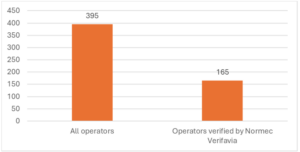
A total of 165 aircraft operators were verified by Normec Verifavia under the ReFuelEU Aviation Regulation for the 2025 reporting year, representing approximately 42% of all operators subject to the Regulation. Collectively, these operators accounted for 22.54 million tonnes of yearly aviation fuel required, 22.88 million tonnes of fuel uplifted at Union airports, and 0.152 million tonnes of yearly tanked quantities for fuel safety rules.
Before we dive into the numbers and the compliance patterns, it’s important to revisit how compliance with the ReFuelEU Aviation works.
- Article 5(1) requires an Aircraft Operator to uplift at least 90% of the fuel required from a Union Airport. If this requirement is not met, Article 5(2) of the Regulation allows aircraft operators to justify the corresponding “non-tanked quantities” reported in Column H (Yearly Non-Tanked Quantity for Fuel Safety Rules). This provision recognises that, due to operational constraints or other legitimate operational reasons, an operator may not always be able to comply with the 90% requirement.
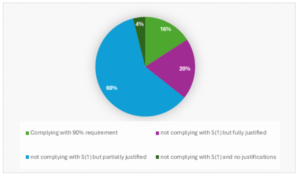
The compliance outcomes reveal several distinct compliance patterns beyond a simple compliant or non-compliant assessment. Out of the verified pool, 16% of operators complied with Article 5(1) by meeting the 90% uplift requirement. 20% of operators did not meet the 90% threshold but were able to justify all non-tanked quantities. 60% of operators were only able to justify part of the non-tanked quantity reported, while 4% operators could not justify any non-tanked quantities at all.
This gives a more realistic picture of how ReFuelEU Aviation is working in practice. The verified numbers show that full compliance remains difficult for many operators, but it also shows that non-compliance does not always mean a weak case. In many instances, the issue is not the presence of non-tanked quantities itself, but whether those quantities are justified under “yearly tanked quantities for fuel safety rules” and are supported by accurate data tracking and supporting evidence.
The main message from this first layer of analysis is simple: compliance is not just about how much fuel was uplifted, but whether the operator can explain the difference when it falls short.
We also notice that the highest number of operators fall under the category of partially justified, implying that most operators had difficulties justifying all the non-tanked quantities they faced. That is where the quality of reporting starts to matter as much as the operational result itself.
The Role of Justification under Article 5(2)
One of the clearest patterns in the 2025 reporting year is that justification quality now separates the operators with manageable non-compliance from those with exposure. Operators with full justification were generally able to show that non-tanked quantities were linked to operational or safety-related considerations and that the supporting evidence was available and traceable. In those cases, the verification process was largely about confirming that the explanation matched the reported data. The more difficult cases were the partial justifications (where the operators were able to justify non-tanked quantities at a few airports but not all). These were the reports where some airports were supported by adequate evidence, but others were not. In various cases, they usually point to gaps in record-keeping or inconsistent data collection rather than a complete absence of an operational reason.
The smallest but most exposed group is the one that could not justify non-tanked quantities at all. In those cases, the report may still contain a reason for uplift behaviour, but without the evidence needed to support it, the outcome remains weak from a compliance standpoint.
Conclusion
This year of ReFuelEU Aviation reporting provides valuable insight into how aircraft operators are implementing and demonstrating compliance with the Regulation. While a proportion of operators met the Article 5(1) uplift requirement across all relevant Union airports, many relied on Article 5(2) justifications to account for non-tanked fuel quantities. The results highlight the importance of robust record-keeping, accurate fuel data, and well-documented supporting evidence in demonstrating compliance.
Want to create a safe and healthy working and living environment?
We test, inspect and certify so organizations can innovate safely, quickly, efficiently and cost-effectively.
Related Services


Related Articles


01 May 2026
ETS 2 First Verification Cycle Complete: Lessons from Early Implementation
ETS 2 verifications have now been completed for the first reporting cycle, marking an important milestone in the expansion of the EU carbon market to transport and building fuels.


01 May 2026
EU Greenwashing Crackdown: What EmpCo and Green Claims Mean for Environmental Marketing
The European Union is significantly tightening its rules on greenwashing through two complementary pieces of legislation: the Empowering Consumers for the Green Transition Directive (EmpCo) and the Green Claims Directive.


18 Jun 2026
The 2026 strategic roadmap: Navigating the final reconciliation of CORSIA phase 1
The first phase of CORSIA is entering its final months. For most operators, the 2025 reporting cycle—verified by independent bodies before April 30, 2026, represented the most rigorous data exercise since the program’s inception. However, a verified report is merely the “input” for a larger financial equation. As we progress through 2026, the industry is operating in a dual-track reality: Retrospective Reconciliation: Finalising the 2025 financial obligations. Prospective Monitoring: Ensuring the 2026 burn year, the final year of the first phase, is tracked with absolute precision ahead of the April 2027 verification deadline.


18 Jun 2026
UK ETS: Treatment of Sustainable Aviation Fuel (SAF) Consultation
The UK Emissions Trading Scheme (UK ETS) Authority has launched a consultation to gather stakeholder views on the future treatment of SAF within the UK ETS framework, particularly in light of the introduction of the UK SAF Mandate. The consultation explores potential changes to SAF eligibility, sustainability requirements, greenhouse gas (GHG) savings thresholds, and accounting methodologies, with the objective of strengthening policy alignment and supporting the decarbonisation of the aviation sector.


17 Jun 2026
Navigating SAF documentation: Common challenges and best practices
As Sustainable Aviation Fuel (SAF) adoption continues to grow under Aviation Regulations, documentation quality and traceability have become key areas of focus during reporting of SAF and verification activities. While SAF offers significant environmental benefits, demonstrating compliance requires operators to maintain accurate, complete, and verifiable records throughout the reporting period. Based on our experience supporting aviation stakeholders with compliance and verification activities, several recurring challenges have emerged. Fortunately, many of these issues can be addressed through early planning and proactive engagement with fuel suppliers and competent authorities.


01 May 2026
EU Launches Carbon Removal Certification Framework (CRCF)
The European Union has taken a significant step toward achieving climate neutrality with the adoption of Regulation (EU) 2024/3012, establishing the Carbon Removal Certification Framework (CRCF).


01 May 2026
CSRD Scope Narrowed: But Are You Still Required to Verify Sustainability Reporting?
The European Commission’s Omnibus “Content Directive” entered into force on 18 March 2026, bringing final clarity to the Corporate Sustainability Reporting Directive after more than a year of negotiation. EU Member States now have until 19 March 2027 to transpose the changes into national law. For organisations subject to CSRD, this is the moment to adjust your verification planning with confidence. The question is no longer whether CSRD will apply it is whether your organization remains in scope, and if not, whether voluntary verification still serves your business objectives.