



Challenges faced
Several issues have been observed in Sustainable Aviation Fuel (SAF) documentation, including inconsistencies in documents issued by different fuel suppliers, lack of harmonization in document formats, Proof of Compliance (POC) documents issued after the expiry of certificates and instances where POCs have been issued, cancelled, and subsequently reissued. Highlighting these common documentation issues aims to raise awareness among operators and encourage them to engage with their fuel suppliers well in advance to clarify and resolve any potential concerns. Proactive coordination can help streamline the verification process, reduce delays, and save valuable time during verification activities.
Engage with fuel suppliers early
One of the most effective ways to reduce SAF reporting and verification challenges is to establish communication with fuel suppliers well before the reporting deadline.
Operators should seek clarity on:
- The SAF documentation that will be provided
- Sustainability certificates supporting the SAF volume
- The expected timeline for certificate delivery, including whether certificates will be issued monthly, quarterly, or at year-end
As mentioned already, addressing these points early can help avoid getting large number of documents at last-minute and reduce delays during SAF emissions reduction reporting.
Clarify regulatory expectations
As regulatory guidance continues to evolve, operators should proactively engage with their respective competent authorities to understand specific authorities’ expectations, if any.
Attention should be given to:
- Acceptance of sustainability documents (For e.g. some authorities accepted Product Transfer Documents)
- Eligibility of specific feedstocks not listed in the Renewable Energy Directive (EU) 2018/2001 for e.g. Animal Fat Cat 3
- Additional reporting instructions for future compliance years
- Expectations related to supporting evidence and SAF claims
Obtaining clarification before reporting begins can provide greater certainty and reduce the risk of non-compliance.
The challenge of harmonisation
The absence of a standardised approach across the supply chain continues to create challenges for operators, fuel suppliers, verifiers, and competent authorities. Inconsistencies in documentation formats, sustainability certificate requirements, and reporting practices can increase the burden on all parties involved. Greater harmonisation across the industry would improve transparency, reduce administrative complexity, and facilitate more efficient reporting and verification.
The importance of SAF tracking
As SAF volumes increase, maintaining a dedicated SAF tracking file is becoming essential for efficient reporting and verification. A structured tracking system enables airlines to record SAF quantities, supplier information, sustainability certificates, and supporting documentation in a single location. This improves traceability, helps identify discrepancies early, and provides a clear audit trail throughout the reporting cycle.
From a verification perspective, effective SAF tracking reduces information requests, supports data consistency, and facilitates a more efficient assessment of SAF claims — ultimately strengthening compliance and reporting accuracy.
Looking ahead: The role of the Union Database
The Union Database (UDB) is expected to play an increasingly important role in SAF traceability and reporting. By providing a centralised system for tracking SAF transactions, the UDB has the potential to improve transparency, reduce documentation inconsistencies, and strengthen confidence in sustainability claims.
As the industry continues to mature, a robust UDB framework will be instrumental in supporting accurate reporting and long-term compliance.
Conclusion
The success of SAF reporting depends not only on fuel procurement but also on the traceability of supporting documentation. Operators that engage early with fuel suppliers, seek clarification from competent authorities, and implement robust document management practices will be better positioned to navigate verification requirements efficiently.
Preparation today can significantly reduce verification challenges tomorrow — helping operators achieve compliance while supporting the industry’s broader sustainability objectives.
Want to create a safe and healthy working and living environment?
We test, inspect and certify so organizations can innovate safely, quickly, efficiently and cost-effectively.
Related Services
Related Articles
15 May 2026
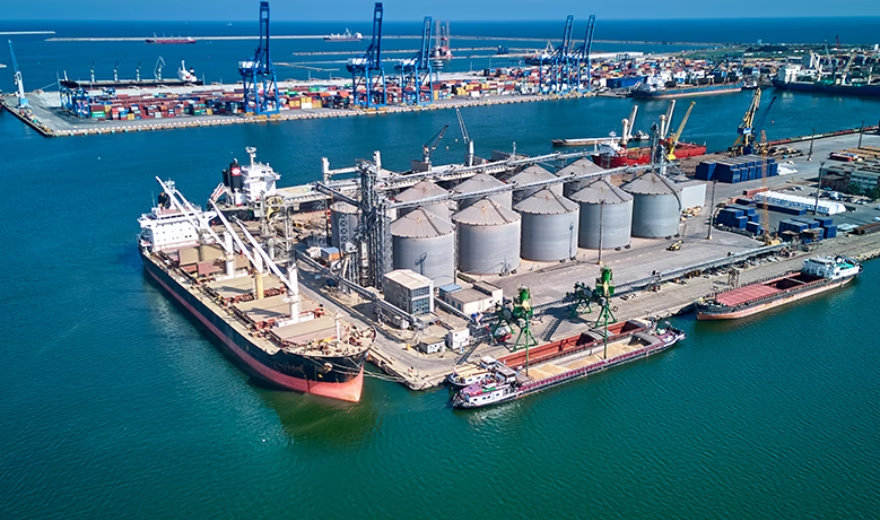
Assessment of the Impact of Low-Carbon Fuels at Sea: A Technical Audit of Emission Reductions and Sustainability Verification.
Freight transport contributes significantly to greenhouse gas emissions. Reducing these emissions is a challenging task due to the complexity and scale of freight networks. Although the financial burden often falls on freight carriers, shippers and logistics service providers (LSPs) can play a crucial role in alleviating this challenge. By collaborating with carriers, they can share the burden and demonstrate their commitment to a low-carbon economy. A promising approach to achieving this is through low-carbon fuel programs.


15 May 2026
Aviation Carbon 2024, a huge success!
Aviation Carbon 2024, co-organized by Normec Verifavia, successfully concluded on November 26, 2024, further solidifying its status as the longest-running “must-attend” sustainability event for the aviation industry. Thank you to all participants for making this possible! The conference brought together various stakeholders, including airlines, fuel suppliers, carbon market experts, policymakers, and environmental organizations, to discuss the latest developments in sustainability, compliance, and implications for the industry.


15 May 2026
Essential compliance for ReFuelEU aviation 2023/2405
The implementation of ReFuelEU imposes obligations on fuel suppliers, Union airports and aircraft operators, which are discussed in the following subsections.


01 May 2026
EU Launches Carbon Removal Certification Framework (CRCF)
The European Union has taken a significant step toward achieving climate neutrality with the adoption of Regulation (EU) 2024/3012, establishing the Carbon Removal Certification Framework (CRCF).


01 May 2026
CSRD Scope Narrowed: But Are You Still Required to Verify Sustainability Reporting?
The European Commission’s Omnibus “Content Directive” entered into force on 18 March 2026, bringing final clarity to the Corporate Sustainability Reporting Directive after more than a year of negotiation. EU Member States now have until 19 March 2027 to transpose the changes into national law. For organisations subject to CSRD, this is the moment to adjust your verification planning with confidence. The question is no longer whether CSRD will apply it is whether your organization remains in scope, and if not, whether voluntary verification still serves your business objectives.

01 May 2026
ETS 2 First Verification Cycle Complete: Lessons from Early Implementation
ETS 2 verifications have now been completed for the first reporting cycle, marking an important milestone in the expansion of the EU carbon market to transport and building fuels.


01 May 2026
EU Greenwashing Crackdown: What EmpCo and Green Claims Mean for Environmental Marketing
The European Union is significantly tightening its rules on greenwashing through two complementary pieces of legislation: the Empowering Consumers for the Green Transition Directive (EmpCo) and the Green Claims Directive.