


Refueleu aviation: new regulation for sustainable aviation
The European Union is working towards a 55% emissions reduction by 2030 through the Fit for 55 package. An important part of this package is Regulation (EU) 2023/2405, better known as ReFuelEU Aviation, which was adopted on 31 October 2023.
This regulation aims to make the aviation sector more sustainable by:
• Promoting the use of Sustainable Aviation Fuel (SAF)
• Limiting fuel tankering (carrying extra fuel to refuel more cheaply elsewhere)
• Improving transparency and reporting on fuel use
Normec Verifavia supports aviation organisations with independent verification of emissions and fuel data, so you can comply with the regulation and report with confidence.
Our approach
Normec Verifavia has extensive experience in validation, verification, and auditing within the aviation sector. Our specialists perform a thorough assessment of emissions data and operational parameters.
This allows you to:
-
1.
Comply with European regulations
-
2.
Report transparently on fuel use
-
3.
Minimise compliance risks
-
4.
Build trust with regulators and stakeholders
With more than 10 years of experience in aviation verification, we provide reliable and accurate verification services.
Who must comply with Refueleu aviation?
The ReFuelEU Aviation regulation applies to various parties within the aviation sector:
• Aircraft operators
• Aviation fuel suppliers
• EU airports
• Airport managing bodies
An aircraft operator falls under the regulation when, in the previous reporting period, it operated:
• At least 500 commercial passenger flights, or
• At least 52 cargo flights departing from airports within the European Union.
An EU airport is an airport that annually handles:
• More than 800,000 passengers, or
• More than 100,000 tonnes of cargo.
What does ReFuelEU Aviation mean in practice for your organisation?
• You must report on fuel use and SAF usage
• You must comply with minimum shares for Sustainable Aviation Fuel (SAF)
• You must prevent the same SAF from being counted multiple times under different schemes
• You must submit reports via the EASA Sustainability Portal
• You must provide transparent and verifiable data

Expertise in aviation emissions and verification
Normec Verifavia is a globally recognised organisation for emissions verification in the aviation sector.
Our experts have in-depth knowledge of:
• Emissions and fuel reporting
• European aviation regulations
• Monitoring methodologies and control systems
• Verification according to international standards
During verification, we review, among other things:
• Flight data and fuel consumption
• Monitoring methodologies
• Internal control systems
• Consistency and completeness of reports
Verification is carried out in accordance with ISO 17029:2019 and ISO 14065:2020, ensuring an independent and reliable verification process.
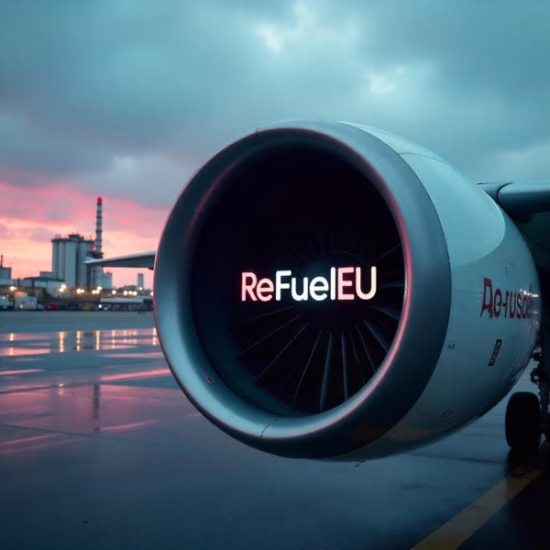
Prepared for the future of sustainable aviation
The aviation sector is undergoing a major transition towards lower emissions and more sustainable fuels. With ReFuelEU Aviation, the European Union is taking an important step towards a future in which Sustainable Aviation Fuel (SAF) plays a central role.
By organising your reporting and verification properly, you can not only comply with regulations but also contribute to a more sustainable and transparent aviation sector.
Would you like more information about ReFuelEU Aviation?
Get access to our recorded ReFuelEU Aviation webinar from 1 December 2025, in which Normec Verifavia experts explain the key requirements and steps.
Fill in the form to get one week of access to the recording.
Would you like to learn more about ReFuelEU Aviation?
Downloads
- ReFuelEU Aviation Template for Aircraft Operators
- List of Union airports established for the purpose of ReFuelEU Aviation
- List of competent authorities of the Member States responsible for enforcing the application of ReFuelEU Aviation
- Re Fuel EU Aviation Brochure
- List of aircraft operators in-scope of ReFuelEU Aviation
You might also be interested in these services







Frequently asked questions about refueleu aviation verification
-
ReFuelEU Aviation is a European regulation that promotes the use of Sustainable Aviation Fuel (SAF) and requires airlines to report transparently on fuel use and emissions.
-
The regulation applies to:
- Aircraft operators
- fuel suppliers
- EU airports
- Airport operatorsWhen certain thresholds for flights or passengers are exceeded, organizations are subject to the obligations of the regulation.
-
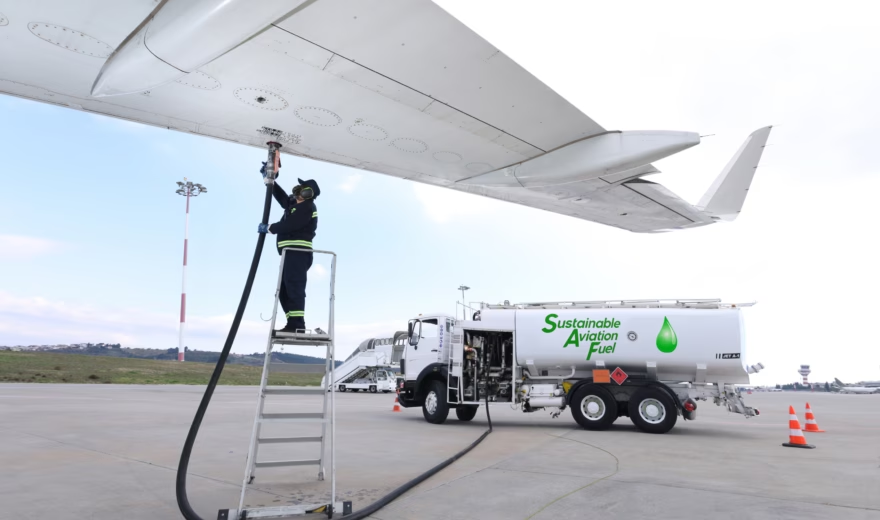
Sustainable aviation fuel (SAF) is a more sustainable type of aviation fuel produced from renewable resources or waste. SAF can significantly reduce lifecycle CO₂ emissions compared to conventional kerosene.
-
Refueling means that aircraft carry extra fuel to refuel more cheaply elsewhere. However, this increases the weight of aircraft, leading to higher fuel consumption and emissions. ReFuelEU Aviation therefore wants to restrict this practice.
-
A key deadline is March 31. Before this date, aircraft operators must submit their annual report through the EASA Sustainability Portal.
-
In some cases, aircraft operators can apply for temporary exemptions, such as for certain short routes or airports on islands without rail or road connections.
-
Normec Verifavia supports organizations with:
- Independent verification of fuel and emissions data.
- Review of reports and monitoring methods
- Preparation of verification reports
- Guidance on compliance with European regulations -
The ReFuelEU Aviation regulation applies to aircraft operators operating flights from EU airports. The obligations apply when an operator has performed at least the following in the previous reporting period (January 1 - December 31)
- 500 commercial passenger flights, or
- 52 commercial cargo flights operated from EU airports. -
Airlines must ensure that flights departing from EU airports have sufficient fuel for the planned flight.
According to Article 5 of the ReFuelEU Aviation Regulation, the total annual amount of fuel refueled at a specific EU airport must be at least 90% of the operator’s total fuel requirement at that airport.
This requirement is intended to prevent fuel over-refueling. -
According to Article 8 of the ReFuelEU Aviation Regulation, aircraft operators must submit a verified report to the competent authority annually.
The first report must be submitted in 2025 and thereafter annually by March 31 (year N+1). The report must include the following:The report must include the following:
Fuel Report
- Total number of flights departing from EU airports
- Total number of flight hours from EU airports
- Total annual fuel requirement (aviation fuel and taxi fuel) per EU airport
- Total amount of fuel refueled per EU airport
- Annual amount of fuel not refueled
- Amount of additional fuel refueled for safety reasonsReport on the procurement of SAF
- Total amount of sustainable aviation fuel (SAF) purchased for scheduled flights
- Details per SAF purchase, such as
o supplier
o Lot number
o Quantity (metric tons)
o Fuel category
o Raw materials used
o Lifecycle emissions
- SAF for which claims are made under schemes such as:
o EU-ETS
o CH ETS
o CORSIA
o Other market-based measures
- SAF for which no claims have been made under other schemesDeclaration
The operator must declare that the same SAF batches have not been claimed multiple times under different emissions schemes. -
Starting in 2025, fines may be imposed if an operator fails to meet the obligations under Article 5, including the requirement that at least 90% of the fuel be refueled.
The amount of the fines is determined by the Member States, but must be at least
twice the average annual fuel price multiplied by the total amount of fuel not refueled. -
In some cases, refueling is permitted to meet the safety requirements of Commission Regulation (EU) No. 965/2012.
Examples of such situations include:
- Fuel shortage at the destination
- Fuel contamination at the destination (confirmed via a NOTAM)
- Operational restrictions at certain airports, such as:
o Very long turnaround times
o Limited airport capacity during peak hoursIn such cases, the operator must specify in the report which airports and flights are affected.
-
No. The obligation to offer a minimum percentage of sustainable aviation fuel (SAF) rests with fuel suppliers at EU airports.
The obligations for aircraft operators are primarily aimed at preventing the use of conventional fuel.
Because fuel suppliers are required to blend SAF into their fuel supply, operators will, in practice, refuel with fuel that contains a minimum percentage of SAF.