

The conference served as an important platform for exchanging knowledge and exploring how robust certification systems can support India’s transition toward a low-carbon, circular economy. Discussions highlighted the growing importance of internationally recognized sustainability standards in enabling market access, ensuring regulatory compliance, and building trust across global value chains.
Advancing Sustainability Through Certification
Throughout the conference, experts shared valuable insights into the latest developments within the ISCC certification schemes and India’s evolving policy framework for renewable energy and sustainable fuels. Key presentations and panel discussions explored topics including:
- ISCC scheme developments and global certification trends
- India’s evolving sustainability and renewable energy policies
- Sustainable Aviation Fuel (SAF)
- Biofuels and biomethane
- Advanced recycling and circular economy solutions
- Renewable Fuels of Non-Biological Origin (RFNBO)
- Life Cycle Assessment (LCA) methodologies
- Sustainability certification and implementation frameworks
A common theme emerged across the sessions: as India’s renewable fuels and circular economy markets continue to mature, the demand for transparent certification systems, independent verification, and reliable sustainability assurance is increasing rapidly. Organizations are increasingly seeking practical solutions that not only demonstrate compliance with evolving regulations but also strengthen credibility with international customers and stakeholders.
Sharing Practical Experience: From Policy to Practice
Normec QS and Normec Verifavia were pleased to contribute to the conference programme through a joint presentation by Iljo Fluit, Managing Director, Verifications & Compliance at Normec QS, and Nicolas Duchene, President & CEO of Normec Verifavia.
Their presentation, “From Policy to Practice: Implementing Certification Frameworks for Renewables”, focused on translating regulatory requirements into practical implementation strategies for organizations operating across renewable fuel value chains.
The session provided attendees with a comprehensive overview of the certification journey, from sustainable feedstock sourcing through processing, mass balance, chain of custody, and final product verification. The speakers also discussed the critical role of traceability, Life Cycle Assessment (LCA), greenhouse gas accounting, and independent third-party verification in meeting both national and international sustainability requirements.
Particular emphasis was placed on helping organizations understand how well-designed certification systems support regulatory compliance while also facilitating access to global markets where verified sustainability credentials have become increasingly essential.
Comprehensive Sustainability Assurance Services
At Normec QS and Normec Verifavia, we provide end-to-end certification, verification, and assurance services that support organizations navigate complex sustainability requirements with confidence.
Our expertise includes:
- Sustainable Aviation Fuel (SAF) verification
- CORSIA verification
- EU Emissions Trading System (EU ETS)
- Lifecycle Assessment (LCA) verification and claims
- Greenhouse gas emissions verification
- Corporate Sustainability Reporting Directive (CSRD) assurance
- ETS 2
- Renewable Transport Fuel Obligation (RTFO)
- UK SAF Mandate compliance
- Insetting solutions
- Sustainability assurance and independent verification
- ISCC EU Certification
- ISCC EU RFNBO Certification
- ISCC PLUS Certification
Supporting India’s Sustainability Journey
With more than 15 years of expertise in decarbonization, Normec QS and Normec Verifavia have supported organizations worldwide in meeting increasingly complex environmental and sustainability requirements.
Our global network is complemented by a dedicated office in Chandigarh, India, where a team of more than 80 experienced auditors and verifiers support businesses across the country. This strong local presence enables us to provide responsive, region-specific expertise while drawing upon the technical knowledge and international experience of the wider Normec Group.
As India’s renewable energy, sustainable fuels, and circular economy sectors continue to expand, we remain committed to helping organizations build resilient, transparent, and compliant sustainability programmes that meet both domestic regulations and international market expectations.
Looking Ahead
We extend our sincere thanks to ISCC – International Sustainability and Carbon Certification for organizing a successful and insightful inaugural conference in India.
The event reinforced the importance of collaboration between industry, policymakers, certification bodies, and sustainability experts in accelerating the transition to a more sustainable future. We look forward to continuing our work with organizations across India and around the world, supporting the growth of sustainable fuels, circular economy initiatives, and robust certification systems that enable measurable environmental progress.
Want to create a safe and healthy working and living environment?
We test, inspect and certify so organizations can innovate safely, quickly, efficiently and cost-effectively.
Related Services


Related Articles


18 Jun 2026
The 2026 strategic roadmap: Navigating the final reconciliation of CORSIA phase 1
The first phase of CORSIA is entering its final months. For most operators, the 2025 reporting cycle—verified by independent bodies before April 30, 2026, represented the most rigorous data exercise since the program’s inception. However, a verified report is merely the “input” for a larger financial equation. As we progress through 2026, the industry is operating in a dual-track reality: Retrospective Reconciliation: Finalising the 2025 financial obligations. Prospective Monitoring: Ensuring the 2026 burn year, the final year of the first phase, is tracked with absolute precision ahead of the April 2027 verification deadline.


18 Jun 2026
UK ETS: Treatment of Sustainable Aviation Fuel (SAF) Consultation
The UK Emissions Trading Scheme (UK ETS) Authority has launched a consultation to gather stakeholder views on the future treatment of SAF within the UK ETS framework, particularly in light of the introduction of the UK SAF Mandate. The consultation explores potential changes to SAF eligibility, sustainability requirements, greenhouse gas (GHG) savings thresholds, and accounting methodologies, with the objective of strengthening policy alignment and supporting the decarbonisation of the aviation sector.


18 Jun 2026
ReFuelEU Aviation Compliance in 2025: Verification Coverage and Compliance Patterns
ReFuelEU Aviation (Regulation (EU) 2023/2405) is one of the European Union’s key measures to reduce aviation emissions by increasing the use of sustainable aviation fuels and discouraging economic tankering. For aircraft operators, Article 5(1) requires that at least 90% of the yearly aviation fuel required for flights departing from a Union airport is uplifted from that Union airport. Where this threshold is not met, Article 5(2) is used for justification, and EASA’s guidance and Monitoring Tool support the monitoring and reporting process. The 2025 reporting year is also the first in which competent authorities can impose penalties for non-compliance with Article 5(1) of the ReFuelEU Aviation Regulation 2023/2405. In 2024, the first reporting year, the main challenge was establishing the monitoring and reporting process itself. In 2025, the picture is more developed. The question is no longer only whether operators are reporting, but what the reports show about compliance behaviour and justification quality. That is where this year’s verified information becomes useful.

17 Jun 2026
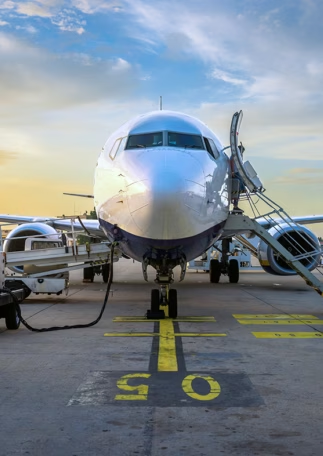
Navigating SAF documentation: Common challenges and best practices
As Sustainable Aviation Fuel (SAF) adoption continues to grow under Aviation Regulations, documentation quality and traceability have become key areas of focus during reporting of SAF and verification activities. While SAF offers significant environmental benefits, demonstrating compliance requires operators to maintain accurate, complete, and verifiable records throughout the reporting period. Based on our experience supporting aviation stakeholders with compliance and verification activities, several recurring challenges have emerged. Fortunately, many of these issues can be addressed through early planning and proactive engagement with fuel suppliers and competent authorities.


01 May 2026
EU Launches Carbon Removal Certification Framework (CRCF)
The European Union has taken a significant step toward achieving climate neutrality with the adoption of Regulation (EU) 2024/3012, establishing the Carbon Removal Certification Framework (CRCF).


01 May 2026
CSRD Scope Narrowed: But Are You Still Required to Verify Sustainability Reporting?
The European Commission’s Omnibus “Content Directive” entered into force on 18 March 2026, bringing final clarity to the Corporate Sustainability Reporting Directive after more than a year of negotiation. EU Member States now have until 19 March 2027 to transpose the changes into national law. For organisations subject to CSRD, this is the moment to adjust your verification planning with confidence. The question is no longer whether CSRD will apply it is whether your organization remains in scope, and if not, whether voluntary verification still serves your business objectives.
01 May 2026
ETS 2 First Verification Cycle Complete: Lessons from Early Implementation
ETS 2 verifications have now been completed for the first reporting cycle, marking an important milestone in the expansion of the EU carbon market to transport and building fuels.