



A New Regulatory Reality
For shipowners, commercial charterers, and ship management companies, carbon pricing is no longer just an EU-bound issue, it is now a domestic British legal requirement. Regardless of a vessel’s flag state, any commercial ship of 5000 gross tonnage (GT) and above calling at a port under UK jurisdiction will be legally required to monitor, report, and surrender emissions allowances for their greenhouse gas (GHG) footprint.
- Core Fundamentals: Scope, Geography, & Exemptions
The maritime UK ETS is structured around precise vessel metrics, greenhouse gas definitions, and geographic voyage parameters. Operators must understand these boundaries to correctly calculate their compliance liabilities.
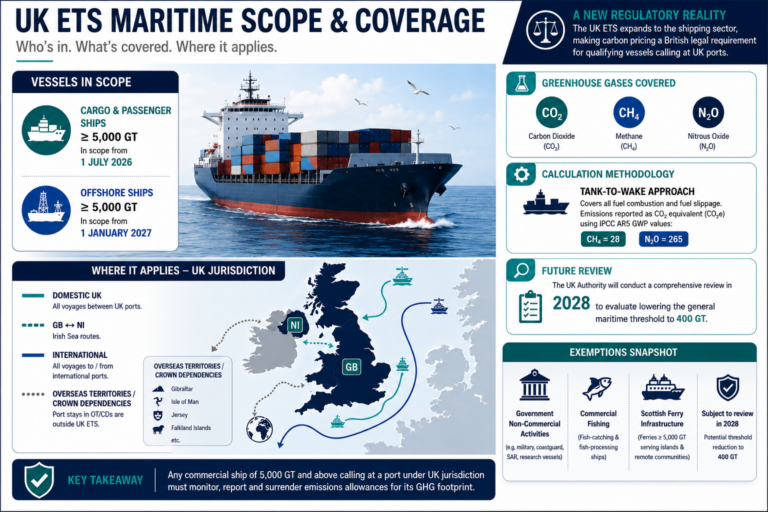
Vessels under Scope
- Cargo and Passenger Ships: Applies strictly to cargo and passenger vessels of 5000 GT and above from launch on 1 July 2026.
- Offshore Ships: The inclusion of offshore ships (5,000 GT+) has been intentionally delayed until 1 January 2027. This strategic delay explicitly aligns the UK timeline with the EU ETS expansion to offshore vessels to prevent market distortions or evasive ship routing.
Emissions under Scope
- Gases Covered: Compliance extends beyond carbon dioxide to include Carbon Dioxide (CO2), Methane (CH4), and Nitrous Oxide (N2O).
- Calculation Framework: Emissions are assessed on a tank-to-wake basis covering combustion and fuel slippage. To ensure accuracy with international reporting standards under the Paris Agreement, methane and nitrous oxide are reported on a carbon dioxide equivalent (CO2e) basis using IPCC Fifth Assessment Report (AR5) Global Warming Potential (GWP) metrics (CH4 = 28; N2O = 265).
(reference: UK ETS: Scope expansion – emissions from international maritime voyages consultation (accessible webpage) – GOV.UK )
Geographic Voyage Matrix
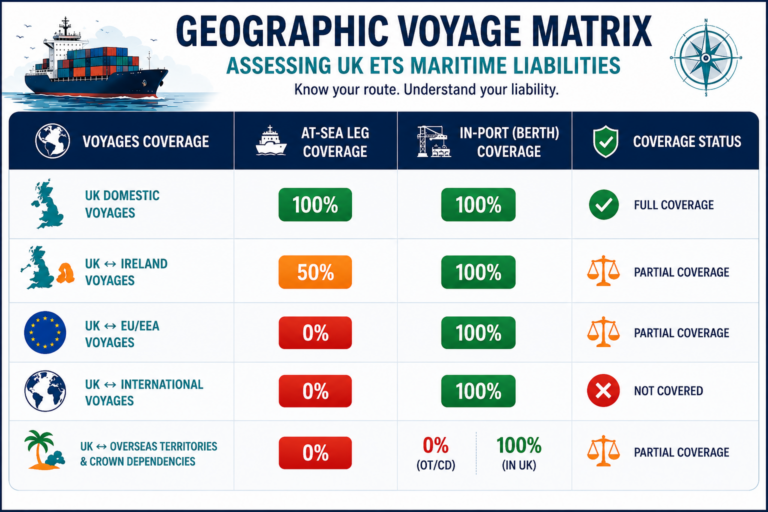
The regulation calculates a company’s total UKAs (UK Allowances) obligations based on specific voyage profiles:
| Voyage Profile / Port Call Location | At-Sea Leg Liability | In-Port (Berth) Liability | Regulatory Context & Cross-Border Nuances |
|---|---|---|---|
| Voyages between UK Ports (Domestic) | 100% | 100% | Includes standard coastal voyages and “cruises to nowhere” that start and end at the same UK port. |
| Great Britain → Northern Ireland | 50% | 100% | Strategically granted a 50% deduction to prevent a carbon pricing disparity across the Irish Sea and eliminate routing evasion through the Republic of Ireland. |
| UK Port → EU/EEA Member State | 0% | 100% | At-sea voyage leg is 0% under UK rules (Note: the EU ETS captures 50% of this at-sea leg) . UK port stays are 100% taxable. |
| UK Port → International Port | 0% | 100% | At-sea international legs are excluded at launch. However, all fuel burned while anchored or moored at berth in a UK port is captured. |
| Voyages to/from UK Overseas Territories / Crown Dependencies | 0% | 0% (in OT/CD)/ 100% (in UK) | Applies to routes involving jurisdictions like Gibraltar, Falkland Islands, Isle of Man, or Jersey. Port stays within the Overseas Territories/CDs are completely exempt. |
UK ETS Exemptions
The UK Authority has established explicit statutory exemptions for UK ETS in a selective scenario –
- Government Non-Commercial Activity: Military, customs/border force, police, coastguard, search and rescue, firefighting, humanitarian aid, and government research vessels are entirely exempt from reporting or surrender obligations.
- Commercial Fishing: Fish-catching and fish-processing ships are excluded to maintain alignment with the EU ETS, where fishing fleets remain outside carbon pricing.
- Scottish Ferry Infrastructure: Ferries over 5,000 GT serving Scotland’s islands and remote peninsular communities are exempt from the scheme. This protects vital supply lines from ticket and freight price impacts, honouring the legal provisions of the Islands (Scotland) Act 2018.
These core exemptions, along with the 5,000 GT threshold, are not permanent. The UK Authority has mandated a comprehensive systemic review in 2028, where they will formally evaluate lowering the general maritime threshold down to 400 GT.
Defining the Operator / Responsible Entity
A critical step for a shipping company is verifying which legal entity carries the point of obligation with the British state.
- The Default Entity: Legal and financial responsibility for compliance rests solely on the Registered Owner of the vessel.
- The Delegation Mechanism: The Registered Owner can choose to formally delegate all UK ETS compliance duties to a third-party ship management company—specifically the ISM Company or Document of Compliance (DOC) holder.
- The Mandate Document: For delegation to be recognized, both parties must execute a legally binding, signed written agreement (mandate document). This mandate must be uploaded into the digital compliance system. If the regulator finds the documentation insufficient or missing, accountability defaults back to the Registered Owner.
(reference link: METS Part 4.2 Delegate UK ETS Responsibility )
The UK ETS Operational Workflow
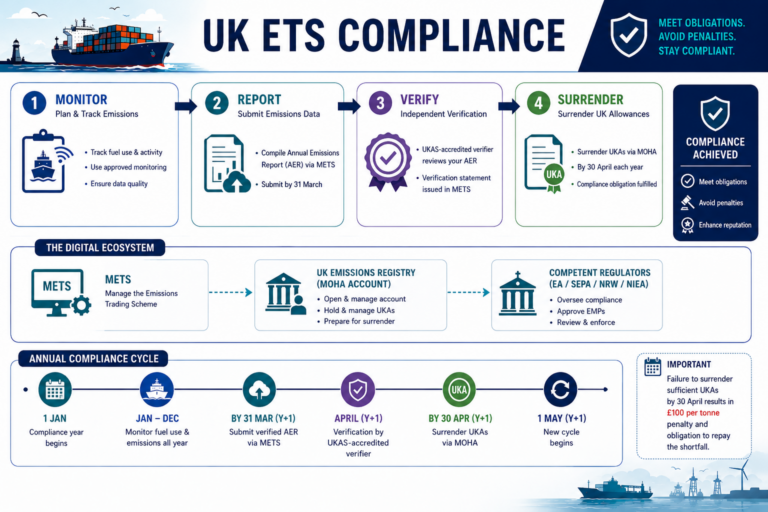
To avoid non-compliance, maritime operators must transition into a rigorous corporate data management cycle.
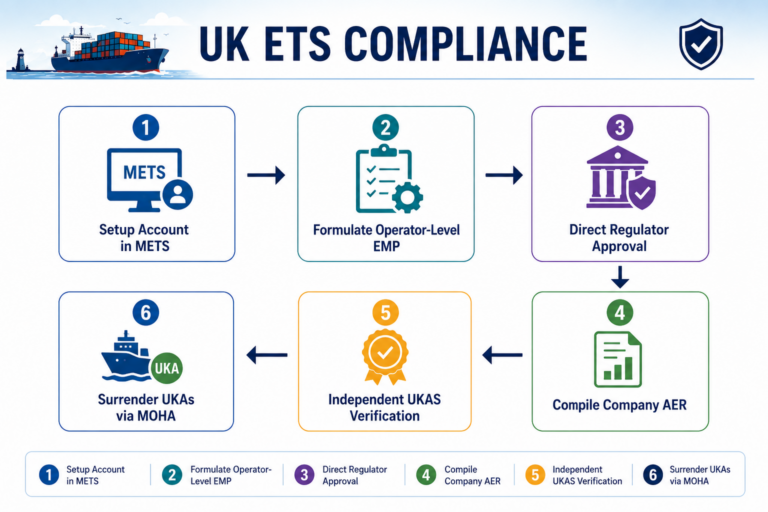
Step 1: Formulating the Emissions Monitoring Plan (EMP)
Every maritime operator must compile a technical Emissions Monitoring Plan (EMP) defining fuel measurement tools, source data tracking, and ship-specific parameters.
- Company Level, Not Ship Level: Operators do not submit individual plans for every vessel. They will maintain only one single corporate EMP that lists and aggregates all in-scope vessels under the company.
- The Approval Workflow: In contrast to traditional MRV & EU ETS , independent third-party verifiers do not need to assess or approve the monitoring plan. The EMP is submitted directly through METS to the assigned UK regulator, who holds sole authority to issue approvals.
- The 42-Day Rule: For any vessel newly entering a company’s fleet or initiating an active voyage under UK jurisdiction, the operator must formally apply for an EMP variation or creation no later than 42 days after that initial maritime activity commences.
(reference link: METS Part 4 EMP Account Details , METS Part 4.1 Emissions Monitoring )
Managing Plan Modifications: Significant vs. Non-Significant Changes
EMP modification, after approval
Significant changes 14 days advance application Add vessel to fleet | Non-significant changes Bundled, due 31 Dec Internal procedure updates |
Once an EMP is approved, future modifications are divided into distinct regulatory classifications:
- Significant Changes (14-Day Advance Application): Material modifications require a formal application to vary the EMP 14 days before the change takes effect. These include adding a vessel to the fleet, introducing new or alternative fuel lines (including sustainable biofuels), updating the fuel monitoring method, changing default emission factors, or utilizing eligible fuel mechanisms for an Emission Reduction Claim (ERC).
- Non-Significant Changes (31 December Annual Deadline): Minor administrative updates such as updating internal corporate procedures or altering basic regulatory contact details can be aggregated and submitted as a bundled variance request by 31 December of the calendar year in which they occur.
Step 2: Compiling the Annual Emissions Report (AER)
Operators must continuously track data across the calendar year to build an aggregate Annual Emissions Report (AER). Like the monitoring plan, the AER is compiled strictly at the company level. It details ship-by-ship fuel breakdowns before mathematically establishing the total corporate emissions footprint.
Step 3: Independent Third-Party Verification
Before an AER can be submitted to the state, it must be audited and signed off by an independent, commercial verifier explicitly accredited by UKAS (United Kingdom Accreditation Service). Verifiers trace voyage logbooks and bunker delivery notes to confirm that the reported emissions align with the parameters in the regulator-approved monitoring plan.
Timeline, Phasing, & The “Double-Surrender” Grace Period
The UK ETS uses a specialized onboarding schedule designed to give shipping companies ample time to adjust to the digital portals before major financial cash outflows occur.
| 2026 | 2027 | 2028 |
|---|---|---|
Until June 30: Voluntary Phase
July 1: Maritime Scheme Launch | March 31: 2026 AER Deadline (Verified) | March 31: 2027 AER Deadline (Verified)
April 30: First Joint Allowance Surrender |
The Initial Abbreviated Scheme Year
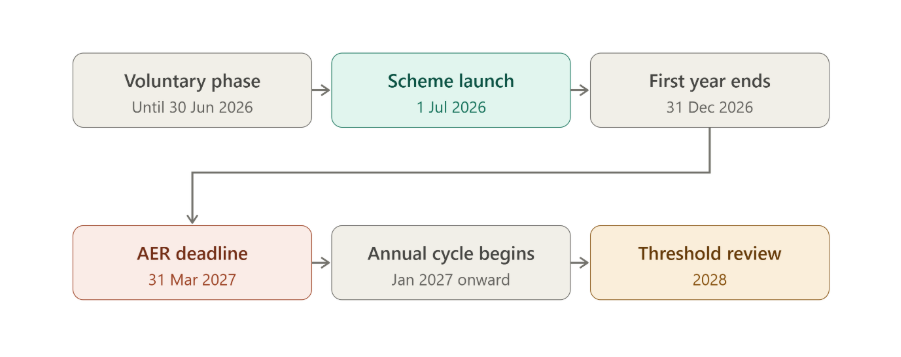
- Voluntary Phase (Until 30 June 2026): The METS portal is fully open for account generation, software familiarization, and EMP uploading free of charge. Monitoring plans approved “in principle” during this phase automatically become formally active at launch.
- Official Launch (1 July 2026): Maritime compliance obligations become law. Operators must track data for an abbreviated six-month scheme year running until 31 December 2026.
- Standardization (2027 Onwards): The scheme returns to a normal twelve-month calendar cycle (1 January to 31 December).
Operational Action Plan for Operators
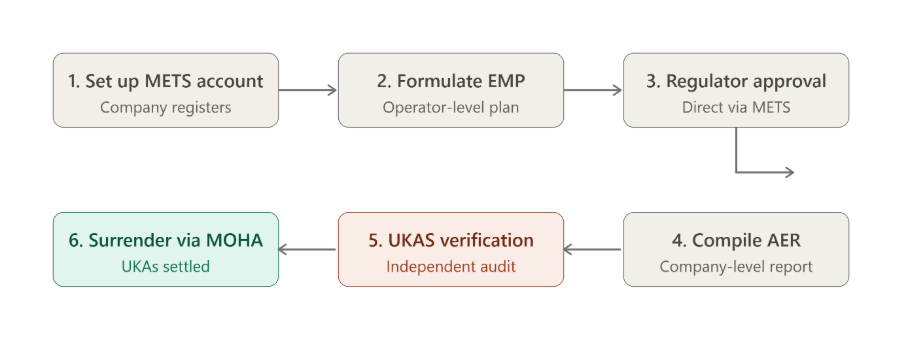
To ensure absolute readiness before state enforcement go live, fleet directors and ship managers should immediately complete the following tracking list:
- Establish Internal Accountability: Formally determine whether the Registered Owner or the ISM ship manager will act as the designated “Maritime Operator” for each vessel in the fleet.
- Execute Legal Mandates: If delegating to an ISM manager, draft and sign formal written mandate documents across corporate boards.
- Register for METS Access: Complete the online registration forms to build the company profile and gain immediate portal capability. (reference links: METS Part 1 Creating an Account , METS Part 2 Sign In 1 )
- Onboard Data Suppliers: Formally select the company’s UKAS-accredited third-party verifier inside the METS platform to enable automated data workflows.
- Establish MOHA Account: Complete the registry administrator’s onboarding steps to establish Maritime Operator Holding Account in the UK Emissions Registry to prepare for future allowance purchases.
- Draft the Single Company Level EMP: Gather fleet technical sheets and fuel tracking methods to map out the aggregate, operator-level monitoring plan for approval. (reference link: METS Part 4 EMP Account Details , METS Part 4.1 Emissions Monitoring )
- Update Commercial Charter-Parties: Review all active time-charter contracts to insert transparent carbon cost allocation and data-sharing clauses.
Want to create a safe and healthy working and living environment?
We test, inspect and certify so organizations can innovate safely, quickly, efficiently and cost-effectively.
Related Services
Related Articles


18 Jun 2026
The 2026 strategic roadmap: Navigating the final reconciliation of CORSIA phase 1
The first phase of CORSIA is entering its final months. For most operators, the 2025 reporting cycle—verified by independent bodies before April 30, 2026, represented the most rigorous data exercise since the program’s inception. However, a verified report is merely the “input” for a larger financial equation. As we progress through 2026, the industry is operating in a dual-track reality: Retrospective Reconciliation: Finalising the 2025 financial obligations. Prospective Monitoring: Ensuring the 2026 burn year, the final year of the first phase, is tracked with absolute precision ahead of the April 2027 verification deadline.


18 Jun 2026
UK ETS: Treatment of Sustainable Aviation Fuel (SAF) Consultation
The UK Emissions Trading Scheme (UK ETS) Authority has launched a consultation to gather stakeholder views on the future treatment of SAF within the UK ETS framework, particularly in light of the introduction of the UK SAF Mandate. The consultation explores potential changes to SAF eligibility, sustainability requirements, greenhouse gas (GHG) savings thresholds, and accounting methodologies, with the objective of strengthening policy alignment and supporting the decarbonisation of the aviation sector.


18 Jun 2026
ReFuelEU Aviation Compliance in 2025: Verification Coverage and Compliance Patterns
ReFuelEU Aviation (Regulation (EU) 2023/2405) is one of the European Union’s key measures to reduce aviation emissions by increasing the use of sustainable aviation fuels and discouraging economic tankering. For aircraft operators, Article 5(1) requires that at least 90% of the yearly aviation fuel required for flights departing from a Union airport is uplifted from that Union airport. Where this threshold is not met, Article 5(2) is used for justification, and EASA’s guidance and Monitoring Tool support the monitoring and reporting process. The 2025 reporting year is also the first in which competent authorities can impose penalties for non-compliance with Article 5(1) of the ReFuelEU Aviation Regulation 2023/2405. In 2024, the first reporting year, the main challenge was establishing the monitoring and reporting process itself. In 2025, the picture is more developed. The question is no longer only whether operators are reporting, but what the reports show about compliance behaviour and justification quality. That is where this year’s verified information becomes useful.


17 Jun 2026
Navigating SAF documentation: Common challenges and best practices
As Sustainable Aviation Fuel (SAF) adoption continues to grow under Aviation Regulations, documentation quality and traceability have become key areas of focus during reporting of SAF and verification activities. While SAF offers significant environmental benefits, demonstrating compliance requires operators to maintain accurate, complete, and verifiable records throughout the reporting period. Based on our experience supporting aviation stakeholders with compliance and verification activities, several recurring challenges have emerged. Fortunately, many of these issues can be addressed through early planning and proactive engagement with fuel suppliers and competent authorities.


01 May 2026
EU Launches Carbon Removal Certification Framework (CRCF)
The European Union has taken a significant step toward achieving climate neutrality with the adoption of Regulation (EU) 2024/3012, establishing the Carbon Removal Certification Framework (CRCF).


01 May 2026
CSRD Scope Narrowed: But Are You Still Required to Verify Sustainability Reporting?
The European Commission’s Omnibus “Content Directive” entered into force on 18 March 2026, bringing final clarity to the Corporate Sustainability Reporting Directive after more than a year of negotiation. EU Member States now have until 19 March 2027 to transpose the changes into national law. For organisations subject to CSRD, this is the moment to adjust your verification planning with confidence. The question is no longer whether CSRD will apply it is whether your organization remains in scope, and if not, whether voluntary verification still serves your business objectives.


01 May 2026
ETS 2 First Verification Cycle Complete: Lessons from Early Implementation
ETS 2 verifications have now been completed for the first reporting cycle, marking an important milestone in the expansion of the EU carbon market to transport and building fuels.