

Tips for applying the ET regulation in practice
The regulation for extraterritorial expenses, often referred to as the ET regulation, is widely used in the temporary employment industry. Earlier we wrote extensively about the conditions for the ET regulation. During Normec VRO's SNA inspections and Forvis Mazars' tax audits, we come across many applications of the ET scheme. Although the temporary employment industry is now often well versed in the arithmetic aspects of the ET regulation, the administrative recording still often proves to be a bottleneck. In this article Julisa Fereijra-Phelipa (Normec VRO) and Marco Zimmerman (Forvis Mazars) discuss some common problems surrounding the ET regulation and provide tips for improvements in administrative processes.
Administrative challenges in applying the ET regulation
During our SNA inspections, we frequently encounter the use of the ET regulation. The SNA Standards Manual contains specific review criteria on the subject of exchange and ET, as outlined in Interpretation Report 2023-014a. Several years ago, we noted irregularities particularly in the correct exchange of different wage components. It now seems that that most staffing agencies have implemented solid processes to ensure that the arithmetic aspect of the exchange is correct. Today, on the contrary, we often run into flaws in the administrative record.
This starts with making it plausible that someone is an ET employee. In practice, it appears that many companies do not or not fully comply with the six conditions of the covenant. For example, essential documents, such as the recruitment list or resident list, are often missing or do not meet the requirements. As a result, staffing companies often rely on the free evidence doctrine. However, it turns out that even in these cases files are often missing or incomplete. With some regularity, we receive files containing only a foreign driver's license, proof of ownership of a foreign car, or envelopes with a mailing address abroad, with no further content. In other words, documents that do not necessarily substantiate the fact that a temporary worker is temporarily residing in the Netherlands because of work.
Common bottlenecks in administration
Another bottleneck is the substantiation of the amount of costs that are exchanged. For example, when reimbursing travel expenses for home leave tax-free, the Tax Office expects proof of expenses incurred. Housing allowances must also be supported by documents such as rental agreements and invoices. These administrative requirements are often overlooked.
Tips for improvement
Julisa Fereijra-Phelipa therefore tips temporary employment organizations to set up the processes in such a way that the administrative requirements are met first, before wages are exchanged. This not only prevents errors, but also gives certainty to both parties. As we often say in the inspection world, "Trust is good, recording is better."
Current issues accruing vacation days
That even after 14 years, the ET regulation still provokes thought, we also notice during our inspections. An example of a current challenge is the accrual of vacation rights. Employees with secondment contracts, who do not use the agency clause, often do not accrue sufficient vacation rights due to the wage exchange.
To understand this properly, it is important to briefly revisit how the agency clause works in conjunction with vacation rights. Article 26(1) of the Collective Agreement for Temporary Workers states that temporary workers are entitled to 16 2/3 hours of vacation or a proportional part thereof per full working month. An exception applies to temporary workers with an agency clause whereby (in 2024) 10.82% must be reserved. In practice, this means that vacation days are reserved in cash when applying the agency clause, and accrued in time when applying a contract without an agency clause.
However, wage exchange creates a challenge in the calculation methodology of temping software: vacation rights are calculated in euros after exchange, but divided by the hourly wage before exchange to pay out at the original wage. This can result in the vacation entitlement in time for employees without a temp clause not being sufficient.
Example
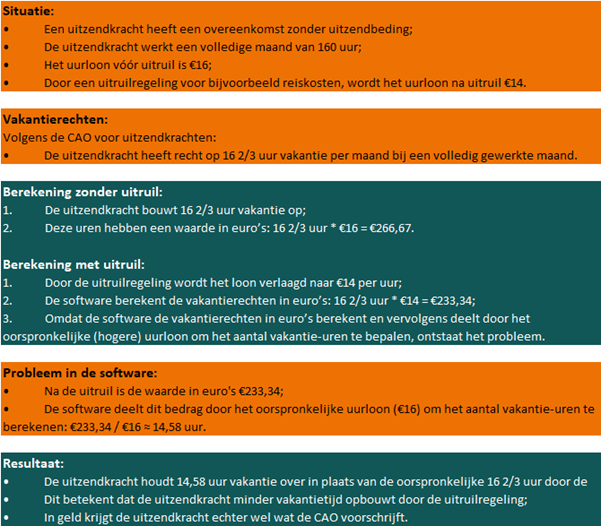
CLA parties ABU and NBBU have explained that when taking and paying out vacation days, the wage after exchange must be used as the starting point. However, this entails implementation problems, especially when the minimum wage is not structurally exchanged. There was no consensus on how to address this for a long time. In May 2024, an agreement in principle was reached on the new CLA for Temporary Agency Workers, which includes an important change: the exchange rate for the ET scheme will change to 100/100 as of January 1, 2025, marking a departure from the exchange rate of 0.81 that had been in force since 2010. According to the new CLA text, which will take effect at the same time, reserves and entitlements will now be calculated on wages before exchange, rather than after exchange, as was the case until the end of 2024. This solves the previous implementation problem for the future.
Consultations are still taking place between SNA, ABU and NBBU on retroactive recovery within the SNA seal of approval, with Normec VRO having an advisory role as the inspection body.
What does this mean for your SNA inspection?
If the above situation occurs, it will provisionally result in a non-conformity that, once there is consensus on the solution, must be restored.
Practical experiences of Forvis Mazars
Temporary employment agencies regularly face tax audits. When they work with migrant workers, the ET regulation is often a point of discussion. Common bottlenecks concern the substantiation of costs that are reimbursed or provided tax-free, but also the question of whether the ET-rule may be applied to an employee. Thorough substantiation is required for tax purposes and may consist of claim forms, receipts, or a comprehensive expense survey-the latter is required for extraterritorial expenses reimbursed as a lump sum.
Common bottlenecks in tax audits.
A major stumbling block is home leave reimbursement. The IRS often requires more proof than just an estimate of the number of trips home; claim forms and additional supporting documents are needed to justify tax-free travel reimbursement. Housing issues also often arise. It happens that a net allowance appears on the paycheck while the employer provides in-kind housing, leading to retroactive tax assessments.
Another issue is the substantiation of the cost of living allowance (COLA), or additional living expenses. LTO amounts are often used, but the Tax Office states that only LTO members may apply these amounts and this is included in the published arrangement with LTO. This means that employment agencies must have their own justification for the COLA allowance, with specific amounts for each country.
Solutions from Forvis Mazars
To meet these challenges, Forvis Mazars has developed its own calculation method for determining the additional cost of living, based on statistics from EUROSTAT. Every six months, Forvis Mazars calculates the difference in cost of living per country, compared to the Netherlands, and sets a weekly tax-free amount that may be paid to employees.
Since the introduction of the statutory minimum hourly wage, the COLA allowance takes into account working hours by sector. To illustrate, a tax-free amount of €33.41 per week can currently be used for Polish workers, and €23.48 for Bulgarian workers for a standard 40-hour work week.
If you would like to know more about the substantiation of COLA amounts or about other aspects involved in a tax audit, please contact Marco Zimmerman.
Need help with certification in your industry?
Need help with certification in your industry?