Penalty calculations under FuelEU Maritime
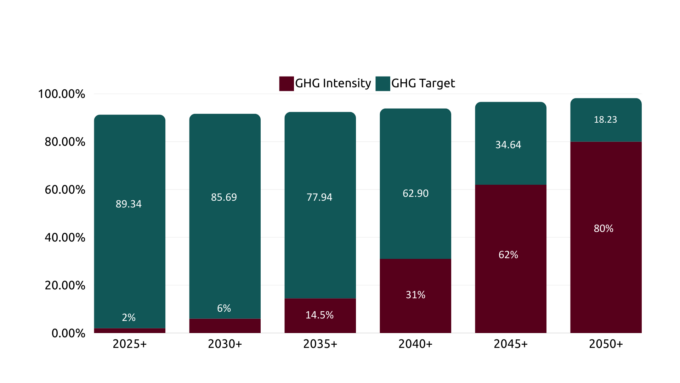
The FuelEU Maritime regulation is designed to reduce greenhouse gas (GHG) emissions from the maritime sector by imposing strict GHG intensity limits and shore power requirements for vessels with gross tonnage greater than 5,000 tons carrying commercial passenger or cargo traffic. The GHG intensity limit, expressed in grams of CO2 equivalent per megajoule (gCO2 eq/MJ), will be progressively tightened, targeting an 80% reduction by 2050 from a baseline of 91.16 gCO2 eq/MJ. Specific annual reduction targets are set at 2% for 2025, 6% for 2030, 14.5% for 2035, 31% for 2040 and 62% for 2045.
Type and timing of penalty implementation:
Non-compliance with GHG intensity: Penalties for non-compliance with GHG intensity requirements apply to the reporting period beginning January 1, 2025. This is when companies must begin complying with the limits for the annual average greenhouse gas intensity of energy used on board their vessels.
Penalty greenhouse gas intensity:
Where:
GHGTarget= GHG intensity target for the reporting year.
GHGAcurrent= GHG intensity achieved during the reporting year.
Energy per fuel type: Mi (Mass of fuel used) x LCVi (Lower calorific value as prescribed).
Non-compliant port of call (OPS): A non-compliant port of call under the FuelEU Maritime regulation exists when a vessel fails to meet the established onshore power supply (OPS) requirements and greenhouse gas (GHG) intensity limits. This regulation is aimed primarily at container ships and passenger ships, but member states have the option to extend these obligations to other ship types. As of Jan. 1, 2030, ships berthed in ports with OPS infrastructure must be connected to it, otherwise they will be considered non-compliant. Exceptions to this requirement are possible if the ship could not have known about the unavailability of OPS or if the OPS is incompatible with the ship's systems.
OPS Penalty = €1.5 × Total Electrical Energy Demand × Total Hours
Prerequisites for penalty calculations:
Calculation of greenhouse gas intensity.
For the 2025 reporting period, let's take an example of a container ship with 100% intra-EU travel, consuming 13,700 mT HFO and 1,600 mT MDO per year to understand the potential penalties for FuelEU Maritime.
The greenhouse gas intensity of energy used on board a ship is calculated using the following formula:
| Main | Aux | ||||
| Fuel Type | HFO | Fuel type | MDO | ||
| Fuel Consumption | 13,700 | MT per year | Fuel consumption | 1,600 | MT per year |
| From source to tank | From source to tank | ||||
| CO2-eq | 13.500 | gCO2eq/MJ | CO2eq | 14.400 | gCO2eq/MJ |
| LCV | 0.0405 | MJ/fuel | LCV | 0.0427 | MJ/fuel |
| RWD | 1.0 | RWD | 1.0 | ||
| Main | Aux | ||||
| Fuel | HFO | Fuel Type | MDO | ||
| Fuel Consumption | 13,700 | MT per year | Fuel consumption | 1,600 | MT per year |
| CO2eq WtT | 13.500 | gCO2eq/MJ | CO2eq WtT | 14.400 | gCO2eq/MJ |
| LCV | 0.0405 | MJ/fuel | LCV | 0.0427 | MJ/Fuel |
| Tank to Wake | Tank to Wake | ||||
| CO2eq TtW | 3.163 | gCO2eq/gFuel | CO2eq TtW | 3.255 | gCO2eq/gFuel |
| Cf(CO2) | 3.1140 | gCO2/gFuel | Cf(CO2) | 3.2060 | gCO2/g Fuel |
| Cf(CH4) | 0.00005 | gCH4/g Fuel | Cf(CH4) | 0.00005 | gCH4/g Fuel |
| Cf(N2O) | 0.00018 | gN2O/g Fuel | Cf(N2O) | 0.00018 | gN2O/fuel |
| GWPCO2 | 1 |
| GWPCH4 | 28 |
| GWPN2O | 265 |
where PWind is the available effective power of the wind-assisted propulsion systems and corresponds to feff * Peff as calculated in accordance with the 2018 Guidelines for the Treatment of Innovative Energy Efficiency Technologies for the Calculation and Verification of the Achieved Energy Efficiency Design Index (EEDI) and the 2021 Energy Efficiency Index for Existing Ships (EEXI) (MEPC.1/Circ.896)
PProp is the propulsion power of the ship and corresponds to PME as defined in the 2018 guidelines on the calculation method of the achieved EEDI for new ships (IMO Resolution MEPC.364(79)) and the 2021 guidelines on the calculation method of the achieved EEXI (IMO Resolution MEPC.333(76)). When shaft engine(s) are installed, PProp = PME + PPTI(i),shaft.
| Reward factor for wind-assisted propulsion - WIND (fwind) | Pwind / PProp |
| 0.99 | 0.05 |
| 0.97 | 0.1 |
| 0.95 | >= 0.15 |
Who is responsible for fines
The primary responsibility for paying FuelEU fines lies with the shipping company. This includes ensuring that the shipping company meets all regulatory requirements, such as meeting greenhouse gas intensity targets and using shore-side power supply systems (OPS) where required. The shipping company is responsible for any failures and associated fines resulting from non-compliance. Although the shipping company may enter into contractual agreements with commercial operators, charterers or fuel suppliers to share or transfer liability for fines, the shipping company remains ultimately responsible.
Submission of fines
Fines must be submitted to the designated administrative authorities of the member state where the ship is registered or operates. These authorities are responsible for ensuring compliance with the FuelEU Maritime Regulation and collecting fines from vessels that fail to comply. Fines are calculated annually based on verified data submitted by the shipping company as part of its compliance report.
Non-compliance with RFNBO Sub-objective: The Renewable Fuels of Non-Biological Origin (RFNBO) sub-objective is aimed at improving sustainable fuel use in the maritime sector, with a 2% target for RFNBO implementation as of Jan. 1, 2034, contingent on verification results showing less than 1% use by 2031. To encourage early implementation, a reward factor of 2 will apply from Jan . 1, 2025 to Dec. 31, 2033, allowing energy from RFNBO to be counted twice in GHG intensity calculations. This framework encourages ship operators to integrate RFNBO into their fuel mix, facilitating the transition to more sustainable maritime practices.
Penalty for RFNBO:
True:
CBRFNBO: This is the value of the compliance balance for RFNBO. It represents the difference between the required and actual use of RFNBO on board the vessel.
41,000: This is a constant that represents the energy equivalent of 1 metric ton of VLSFO (Very Low Sulphur Fuel Oil), which corresponds to 41,000 MJ.
Pd: This is the price difference between RFNBO and fossil fuel compatible with ship installation. It reflects the additional cost of using RFNBO compared to traditional fossil fuels.
Calculation of penalties.
Penalties for exceeding the GHG intensity target are calculated in accordance with Article 23.2 and Annex IV of the Marine Fuel EU Regulation.
| Input | ||
| GHG target | 89.34 | gCO2eq / MJ |
| Actual GHG | 91.49 | gCO2eq / MJ |
| Fuel consumption | 13,700 | HFO mT per year |
| Fuel consumption | 1,600 | MDO mT per year |
| LCV HFO | 0.0405 | MJ / gFuel |
| LCV MDO | 0.0427 | MJ / gFuel |
| Shore power Ek | 0 | |
| Power | ||
| Compliance Balance Sheet | -1,124,607,500 | gCO2eq |
| Fuel EU Penalty | €857,105.81 | € / year |
For RFNBO Sub-target
Where
CBRFNBO = compliance balance in MJ of RFNBO sub-objective referred to in Article 5(3)
= Annual sum of energy used from RFNBO and/or from fuels providing equivalent GHG emission reductions as referred to in Article 5
Non-compliant port of call (OPS penalty): In addition to penalties for non-compliance with GHG intensity, penalties are also imposed on ships that do not use OPS at ports that have such facilities. The penalty for not using OPS is calculated based on the total electricity consumption of the vessel and the total number of hours of non-compliance.
Calculation example: Suppose a ship with a total electricity consumption of 500 kW did not use OPS for 30 hours at its berth. The fine is then calculated as follows:
OPS Penalty = €1.5 × Total Electric Power Demand × Total Hours
OPS Penalty = €1.5 × 500 kW × 30 h = €22,500
AFIR ports are ports designated under the Alternative Fuel Infrastructure Regulation to provide the necessary alternative fuel infrastructure, including Onshore Power Supply (OPS). These ports must install and maintain infrastructure that allows ships to be connected to OPS while docked, thereby reducing emissions from ships at berth.
P.S. Keep in mind that non-compliant port call penalties (OPS) will be introduced for container ships in 2030.
Additional factors
- Wind-assisted propulsion: The reward factor for wind-assisted propulsion is determined based on the effective power of the wind-assisted propulsion systems relative to the propulsive power of the vessel.
- Determination of fuel mass: Fuel mass Mi is determined based on reporting under Regulation (EU) 2015/757, using the monitoring methodology chosen by the shipping company.
- Greenhouse gas emission factors: Default values for WtT and TtW greenhouse gas emission factors are provided in Annex II. For fossil fuels, only default values are used unless certified under recognized schemes for biofuels and other alternative fuels.
Penalties for non-payment of fines.
Failure to pay required fines has serious consequences. If fines are not paid on time, the vessel will not receive a valid FuelEU compliance document. This document is essential for the legal operation of the vessel in EU ports and waters. Without this document, the vessel may be subject to administrative penalties, including
- Operational restrictions: Ships without a valid compliance document may be restricted from operating in EU ports and waters, affecting their ability to do business in the region.
- Financial penalties: Continued default may result in further financial penalties and interest charges, increasing the overall cost to the shipping company.
- Reputational damage: Non-compliance and non-payment of fines can damage the reputation of the shipping company and affect relationships with customers, partners and regulatory authorities.
To avoid these significant consequences, it is paramount for shipping companies to ensure that all fines are paid in a timely manner and that the FuelEU Maritime Regulation is complied with. This not only helps avoid financial and operational consequences, but also supports the EU's broader climate goals by promoting sustainable and environmentally responsible maritime activities.
Start compliance now
Normec Verifavia is an independent emissions verifier verifying emissions under EU MRV, UK MRV, IMO DCS, CII, EU ETS, FuelEU Maritime since the implementation of these regulations and has verified more than 2,000 vessels from 180 shipping companies in 40 countries. Our innovative emissions dashboard can help you generate the FuelEU Monitoring Plan by retrieving common sections from the EU ETS Monitoring Plan and the functionality to clone FuelEU Monitoring Plans for your fleet, which is currently not available on THETIS. Contact us today for a demonstration of our emissions dashboard connected to over 8 IT systems for seamless emissions verification and compliance.
Questions?
Our experts are ready to assist you