Accessibility links Skip to main content

Beyond the Annual Cycle: Unlocking the Value of Continuous Verification

As time progresses, climate-related requirements in aviation are becoming more complex, more interconnected and, in many cases, mandatory. An airline operating across multiple jurisdictions may now find itself subject to several reporting and compliance schemes at the same time, including EU ETS, UK ETS, CORSIA, ReFuelEU Aviation, Non-CO₂ Aviation Effects reporting and national requirements such as the French Decree.

Continue reading
Commercial passenger aircraft in flight above a cloud layer under a clear blue sky, representing aviation, air travel, safety, and global connectivity.

While the regulatory requirements themselves are becoming more sophisticated, one practical challenge remains largely unchanged: the compliance deadline does not move, even when the work required to meet it becomes more complicated. 

For many airlines, particularly those with limited resources, manual processes or a small compliance team, the period immediately before the reporting deadline can become extremely demanding. Data for different schemes needs to be collected from multiple departments, reviewed, reconciled, supported by appropriate documentation and submitted to the verifier. Any subsequent verifier queries then need to be investigated and resolved, often involving operations, fuel, finance, procurement, IT and other internal stakeholders. 

From annual verification to continuous assurance 

The annual verification model will remain important. However, there is a strong case for moving towards a continuous verification approach, particularly for airlines subject to multiple schemes with medium to large fleet and subject to large number of reportable flights. It is not necessarily to have large number of flights to enter continuous verification format, but if you are reporting it first time or initial reporting years of obligation it’s an added advantage.  

Instead of waiting until the beginning of the following year to review twelve months of data, the operator can provide data and supporting evidence periodically, for example, every three or six months. The verifier can then review the information while it is still relatively recent and identify potential gaps or inconsistencies much earlier. 

From an operator’s perspective, this changes the nature of verification. 

Verification is no longer simply a final check before submission. It becomes an ongoing assurance mechanism throughout the reporting year. 

For example, if an airline starts preparing its data only from 1 February to submit its complete annual data package for EU ETS, UK ETS, CORSIA, ReFuelEU Aviation, Non-CO₂ Aviation Effects, or other applicable requirements, there may be only a limited window to identify and resolve data gaps, reconcile inconsistencies, obtain supporting evidence, address verification queries, and make any necessary corrections before the regulatory deadline. Starting the preparation process this late can therefore create significant time pressure, particularly where data must be collected from multiple sources, reviewed internally, and subsequently verified before submission. If an issue relates to data from several months earlier, the responsible department may need significant time to investigate on what happened, retrieve supporting documents or explain an unusual data/values. 

By contrast, if the same data is reviewed quarterly, many of these issues can be identified resolved and closed when the information is still fresh. 

A missing document can be requested from the relevant department immediately rather than trying to reconstruct the evidence/fill data gaps, almost a year later. A calculation inconsistency can be investigated before it becomes consistent and part of the annual dataset in each month. An unusual fuel uplift value or SAF claim can be challenged and clarified while the relevant operational records are still easily accessible. 

This is a significant practical advantage. 

Identifying potential data related gaps/errors, when they are still manageable 

One of the greatest benefits of continuous verification is early identification of errors. 

In aviation emissions reporting, seemingly small issues can sometimes have a wider impact. A change in fuel data source, a revised workflow, an incorrect conversion factor, a change in flight classification, an incomplete SAF document package or an inconsistency between operational and financial systems can potentially affect a larger population of data. If such an issue is identified during the annual verification, the operator may need to revisit months of historical data. If it is identified during a quarterly review, the affected period is much smaller, and corrective action can be taken immediately.  

The same principle applies to IT systems and workflows. Sometimes the required solution is not simply a correction in an Excel file. The operator may need to change an internal process, modify an IT system or coordinate with a third-party data provider. These changes take time to understand, test and implement. Continuous verification provides that time. 

It allows the operator to move from “What went wrong?” at year-end to “How do we prevent this from happening again?” during the year. 

Better visibility for management and finance 

Knowing the approximate emissions, SAF volumes, tentative proportionality factor and other relevant compliance information several months in advance gives management and finance teams greater visibility of the potential compliance position. 

For example, if an airline has a reasonable understanding of its expected emissions and SAF-related obligations by September or October, finance teams can begin considering the associated financial requirements earlier. Procurement decisions, budgeting and internal approvals can therefore be planned proactively rather than being initiated only after the verification process is substantially complete. 

In other words, better and early data assurance can support better business planning. 

Building regulatory knowledge throughout the year 

Continuous verification also creates an opportunity to identify knowledge gaps. This also provide an important advantage in understanding patterns and discrepancies in the data. When data is reviewed only once at the end of the year, an unusual value/s may be identified, but understanding whether it is a genuine operational pattern, a one-off event, a data-entry issue or a systematic problem can be difficult. With periodic reviews, the operator and verifier can observe trends over several reporting quarters and compare them with operational activities, fuel consumption, flight characteristics or other relevant parameters. Recurring discrepancies can therefore be investigated at their source rather than repeatedly corrected at reporting stage. This also helps the operator determine whether a change in methodology, workflow, system configuration or internal responsibility is required. Over time, the organisation can move from simply identifying discrepancies to understanding why they occur and implementing sustainable corrective actions, resulting in stronger data controls and more reliable reporting. 

Climate regulations are evolving rapidly. Reporting scope, Union airports, SAF eligibility and claims, offsetting units, sustainable fuel requirements and other technical details can change from one reporting year to the next. The information often needs to be correctly interpreted, communicated and implemented across several departments. 

Continuous verification also creates a regular opportunity for knowledge sharing and capacity building within the airline. As regulatory requirements evolve and new reporting obligations are introduced, periodic discussions with the verifier can help the focal point and other responsible personnel identify areas where further clarification or training may be beneficial. Rather than addressing these knowledge gaps just before the reporting deadline, the airline can take corrective action well in advance and ensure that the relevant teams understand the requirements before they become operational or reporting issues. Targeted training on specific regulatory programmes during the year can therefore complement overall MRV process and help keep the responsible personnel prepared for both existing and emerging requirements. This creates a more proactive learning cycle, where verification does not only identify data or compliance gaps, but also helps the organisation strengthen its understanding and internal capabilities over time. 

Click here for more information about the training programmes.

From compliance service to value-added assurance 

Continuous verification should therefore not be viewed simply as “annual verification divided into four pieces.” 

It represents a different service philosophy. 

The objective is to provide the operator with proactive assurance, earlier visibility and better control over the reporting process. 

For operators, it means fewer year-end surprises, better data quality and a more predictable compliance process along with a premium, value-added service. Ultimately, the question is not whether airlines can complete annual verification. They can, and many have been doing so successfully for years. 

The question is whether the annual cycle remains the most efficient and effective approach as aviation climate regulation becomes increasingly complex. 

We believe the answer is increasingly no. 

The future of verification will move progressively towards a model where assurance is embedded throughout the reporting year rather than concentrated at its end. Continuous or quarterly verification can help airlines identify issues earlier, improve data quality, reduce year-end pressure and give management greater confidence in their compliance position. 

At Normec Verifavia, continuous verification is being developed as a premium, value-added service to support operators in moving towards earlier and more proactive compliance. While the approach can provide value to any operator seeking greater control over its reporting process, the benefits become particularly significant for airlines with large-scale operations, high data volumes and multiple regulatory obligations. For such operators, even a relatively small data-quality issue can affect a significant number of flights, making early identification and resolution particularly valuable. Continuous verification does, therefore, require a higher level of engagement and is offered at a premium compared with a conventional annual verification approach. However, the additional investment can provide greater value through reduced year-end pressure, earlier identification of discrepancies, improved data quality, better internal coordination and greater visibility of the operator’s compliance position throughout the year. In this sense, continuous verification is not simply a different verification frequency; it is a more proactive assurance model designed to provide greater value where the scale and complexity of an operator’s activities justify it.

Do you want to create a safe and healthy work and living environment?

We test, inspect, and certify so that organizations can innovate safely, quickly, efficiently, and cost-effectively.

Request a quote

Fill out the form and we will contact you shortly.

Name
In which country would you like the service to be carried out?
Privacy Policy 

Contact us

Fill out the form and we will contact you shortly.

Name
In which country would you like assistance?
Privacy Policy 

Related news articles

A passenger plane is flying at cruising altitude beneath a clear sky with clouds.
18 Jun 2026

The Strategic Roadmap for 2026: The Path to Final Settlement of CORSIA Phase 1

The first phase of CORSIA is entering its final months. For most operators, the 2025 reporting cycle—which will be verified by independent bodies by April 30, 2026—represented the most demanding data processing operation since the program’s inception. However, a verified report is merely the “input” for a larger financial calculation. As 2026 progresses, the sector is operating in a two-track reality: Retrospective reconciliation: finalizing financial obligations for 2025. Forward-looking monitoring: Ensuring that the 2026 emissions year—the final year of the first phase—is tracked with absolute precision in the run-up to the April 2027 verification deadline.

15 May 2026

Essential compliance for ReFuelEU aviation 2023/2405

The implementation of ReFuelEU imposes obligations on fuel suppliers, Union airports and aircraft operators, which are discussed in the following subsections.

An airplane is on the airport apron while ground handling operations are being carried out.
18 Jun 2026

Compliance with the ReFuelEU Aviation Regulation in 2025: Verification Scope and Compliance Patterns

ReFuelEU Aviation (Regulation (EU) 2023/2405) is one of the European Union’s key measures to reduce aviation emissions by increasing the use of sustainable aviation fuels and discouraging economic refueling. For aircraft operators, Article 5(1) stipulates that at least 90% of the annual aviation fuel required for flights departing from an airport in the Union must be refueled at that airport in the Union. If this threshold is not met, Article 5(2) is invoked as justification, and EASA’s guidelines and monitoring tool support the monitoring and reporting process. The 2025 reporting year is also the first year in which competent authorities may impose penalties for non-compliance with Article 5(1) of the ReFuelEU Aviation Regulation 2023/2405. In 2024, the first reporting year, the biggest challenge was setting up the monitoring and reporting process itself. By 2025, the picture has become clearer. The question is no longer just whether operators are reporting, but what the reports reveal about compliance behavior and the quality of the justifications provided. That is where this year’s verified information comes in handy.

Sign up for the newsletter

Stay up to date on the latest news, exclusive updates, and valuable insights.

Sign up

Fill in the form and you’ll receive our newsletter shortly.

Naam
Privacy Policy 

Related services

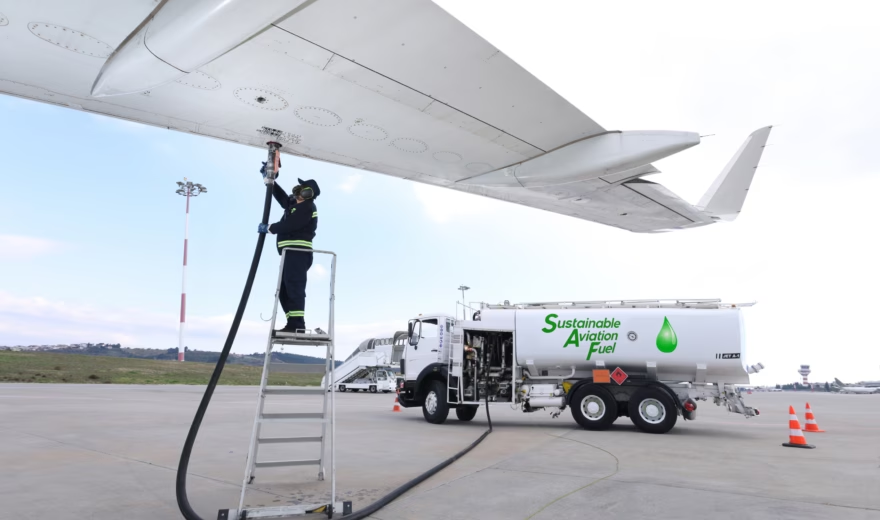
An aircraft is refueled on an airport apron using a hose connected to a fuel truck. The image depicts an operational process in the aviation industry, with a focus on safety, inspection, compliance, and quality assurance.

SAF Program Assurance (SPA) Audit

A passenger plane is flying at high altitude under a clear blue sky with a few scattered clouds and bright sunlight. Suitable for themes such as aviation, safety, inspection, and international services.

Carbon Offsetting and Reduction Scheme for International Aviation (CORSIA)

Commercial passenger aircraft flying above clouds during takeoff or landing, representing aviation, air transport, safety, operational performance, and regulatory compliance within the aviation industry.

Aviation & SAF