Overview of verification in 2024.
In 2024, a total of 358 operators were subject to ReFuelEU Aviation (RFEUA) requirements. As the verifier, Normec Verifavia conducted independent verifications for 128 of these operators to ensure that the reported data is consistent with the regulatory standards in the RFEUA framework. However, of the 128 verified operators, only 14 operators successfully met the key requirement of Article 5.1 of the regulation (operators must refuel at least 90% of the aviation fuel required for their flights at Union airports during the reporting period). The low compliance rate among verified operators indicates that there are many cases with operational constraints, fuel availability problems or route restrictions that prevent airlines from refueling 90% of the required fuel at Union airports. This shows the importance of carefully checking flight data and related documentation. As ReFuelEU Aviation imposes penalties starting next year, it is important to take early action on data accuracy to ensure successful compliance.
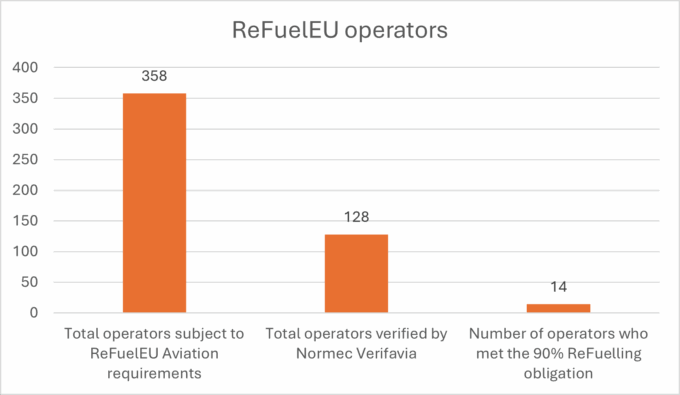
This chart shows that 358 operators were subject to ReFuelEU requirements, 128 were audited by Normec Verifavia, representing a 35.8% market share for ReFuelEU.
Challenges during the first verification cycle
-
1.
Unclear guidelines for missing data:
A major challenge for operators was the unclear guidelines for managing gaps in their flight data. The lack of standardized procedures resulted in different operators using different approaches. Verifiers then had to navigate these inconsistencies during the verification process, which affected the consistency of the reported data.
-
2.
Late submission of data:
Many operators submitted their data at the last minute, causing significant delays in the verification process. These delays were often due to misunderstandings about the specific data points and methodologies required under ReFuelEU Aviation. In addition, difficulties in finding critical documents by the operator - such as final operational flight plans, fuel receipts, technical logs, ACARS messages, etc. - made the verification process difficult.
-
3.
Incomplete reporting of fuel data:
In several cases, important fuel-related data points needed for accurate calculations were missing. The lack of contingency fuel, alternate fuel and blocking fuel data meant operators were unable to justify their safety fuel levels, which in turn limited the scope of operator reporting.
Operator requirements for smooth ReFuelEU aviation reporting for 2025
-
1.
Comprehensive data collection:
Operators should systematically collect and monitor all essential fuel-related data, including trip fuel, cab fuel, ramp fuel, ramp fuel, ramp fuel and all ancillary safety fuels (e.g., contingency fuel, final reserve fuel, alternate fuel, home fuel, etc.). Pre-flight data should also be available to justify instances where the 90% annual monitoring requirement is not met at a given Union airport.
-
2.
Exemption requirements:
The ReFuelEU aviation regulation recognizes that strict compliance with the 90% fuel elevator is not always feasible due to legitimate operational and safety considerations. To address this, the regulation provides several exemptions and justifications, all of which are managed through the EASA Sustainability Portal. These include route-based exemptions based on serious and recurring operational problems, such as limited ramp space affecting turnaround time, and structural fuel supply problems due to geographic constraints. In all cases where the 90% upward displacement threshold is not met for fuel safety compliance, aircraft operators must provide detailed justification to their competent authority and EASA.
-
3.
Timely reporting and verification:
To ensure adequate time for verification, fuel data should be submitted to the verifier no earlier than January 15 of the reporting year. This ensures that the verification process is completed well before the March 31 deadline for annual reporting, which operators must meet.

Use of EASA's ReFuelEU Aviation Sustainability Portal.
EASA's ReFuelEU Aviation Sustainability Portal serves as a central platform for aircraft operators and competent authorities. Aircraft operators can use the portal to manage exempt flight approvals and report data related to their RefuelEU obligations at EU airports. EU Member States' competent authorities can review exemption requests submitted by aircraft operators through the ReFuelEU Aviation Sustainability Portal. Once logged in, you can access the guides and frequently asked questions (FAQs) available on the portal itself.
Conclusion
The first year of ReFuelEU Aviation has shown that while the regulation provides a strong direction for the use of sustainable aviation fuels and takes a hard line on economic fueling, many operators still have issues with data accuracy, fuel planning and timely reporting. With only a few operators currently complying with the fuel quantity requirement, it is clear that better data management and early action will be essential. As fines for noncompliance begin next year, operators should work closely with verifiers to ensure smooth and successful reporting in the future.
Want to create a safe and healthy working and living environment?
We test, inspect and certify so that organizations can innovate safely, quickly, efficiently and cost-effectively.
References
- European Commission. (October 2023). ReFuelEU aviation regulation.
- List of aircraft operators subject to 2024 monitoring and reporting in 2025
- IATA. (September 2024). ReFuelEU handbook for aviation.
- European Commission. (October 2024). Interpretative guidelines on the application of the exemptions referred to in Article 5 of Regulation (EU) 2023/2405.