


Why this matters
Scope 3 SAF Environmental Attribute Certificates, enabled through Book and Claim systems, allow airlines, freight forwarders, and corporates to claim emissions reductions linked to SAF without direct access to the fuel. This mechanism is essential to scaling SAF deployment. But its credibility depends on transparent data, clear accounting guidance, and robust verification. Today, inconsistent certificate structures and incomplete information undermines confidence for stakeholders seeking to integrate SAF into their climate strategies.
What the white paper covers
The report provides a structured analysis of the current SAF certificate landscape, including:
- The state of the SAF market and its development challenges
- Existing gaps in SAF accounting guidance
- A comparative analysis of seven voluntary Scope 3 SAF certificates
- Key findings on data consistency, transparency, and completeness
The analysis, based on certificates issued by airlines and fuel suppliers across multiple regions, reveals significant variations in data quality and the availability of key information.
The need for greater consistency
The findings are clear: SAF certificates need for greater consistency in design and implementation. Transparent data, aligned accounting approaches, and clear documentation are prerequisites for credible emissions claims.
As an independent verifier, Normec Verifavia brings direct expertise to this challenge. Robust, standardized monitoring, reporting and verification practices are essential to maintain integrity across SAF reporting frameworks and prevent double-counting.
Access the full report, “Comparative analysis of Scope 3 SAF certificates,” to explore the detailed findings and recommendations.
Want to create a safe and healthy working and living environment?
We test, inspect and certify so organizations can innovate safely, quickly, efficiently and cost-effectively.
Related Services


Related Articles


22 May 2026
Addressing Non-CO₂ Impacts in Aviation: A Path to Sustainable Flights.
Introduction Aviation's environmental impact goes beyond CO₂ emissions, with non-CO₂ effects such as contrail formation and nitrogen oxides (NOₓ), playing a significant role in global warming. To address this, the European Commission Implementing Regulation (EU) 2024/2493 extends the Monitoring, Reporting, and Verification (MRV) framework to cover non-CO₂ aviation effects, marking a significant step toward sustainable aviation practices. Consequently, from January 1st, 2025, aircraft operators will have to monitor their non-CO₂ effects.


20 May 2026
Navigating ICAO’s CORSIA in the First Phase
As CORSIA enters its first phase (2024–2026), significant changes to the compliance requirements have been introduced starting in 2024, marking a shift in regulatory standards and expectations; the most notable being the shift in the baseline to 85% of 2019 CO₂ emissions subject to offsetting requirements. With a likely positive sectoral growth factor (SGF), aircraft operators will need to cancel emission units for the coming years and submit an emission unit cancellation report (EUCR) for the first phase (2024–2026). To meet these requirements, operators can also use fuels eligible under CORSIA and benefit from the resulting reductions.
19 May 2026
FuelEU Maritime - Compliance Steps for Ship Operators
FuelEU Maritime is a crucial regulation aimed at decarbonizing the maritime industry, in line with the EU’s overarching climate goals. This guide provides in-depth insights and specific operational details that are essential for shipping companies to effectively ensure compliance and strategically plan their operations.


19 May 2026
CORSIA 2024: Important Updates and Compliance Guidelines for Operators of EEA and Non-EEA Aircraft
The Carbon Offsetting and Reduction Scheme for International Aviation (CORSIA), developed by the International Civil Aviation Organization (ICAO), is the first global market-based initiative aimed at achieving carbon-neutral growth in aviation starting in 2020. The framework for CORSIA is set out in Annex 16, Volume IV of the Convention on International Civil Aviation, and is designed to offset CO2 emissions above 2019 levels. It includes requirements for the monitoring, reporting, and verification (MRV) of emissions and the implementation of offset mechanisms. With the publication of the second edition of SARP Annex 16, Volume IV—which takes effect on July 31, 2023, and applies starting January 1, 2024—significant updates have been implemented. These changes apply to both operators from the European Economic Area (EEA) and operators from outside the EEA. This newsletter provides an overview of the most important updates to the SARPs and relevant EU directives.
15 May 2026
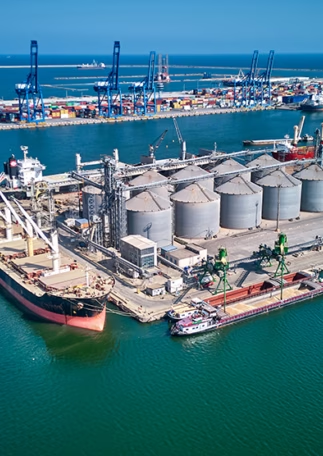
Assessment of the Impact of Low-Carbon Fuels at Sea: A Technical Audit of Emission Reductions and Sustainability Verification.
Freight transport contributes significantly to greenhouse gas emissions. Reducing these emissions is a challenging task due to the complexity and scale of freight networks. Although the financial burden often falls on freight carriers, shippers and logistics service providers (LSPs) can play a crucial role in alleviating this challenge. By collaborating with carriers, they can share the burden and demonstrate their commitment to a low-carbon economy. A promising approach to achieving this is through low-carbon fuel programs.


15 May 2026
Aviation Carbon 2024, a huge success!
Aviation Carbon 2024, co-organized by Normec Verifavia, successfully concluded on November 26, 2024, further solidifying its status as the longest-running “must-attend” sustainability event for the aviation industry. Thank you to all participants for making this possible! The conference brought together various stakeholders, including airlines, fuel suppliers, carbon market experts, policymakers, and environmental organizations, to discuss the latest developments in sustainability, compliance, and implications for the industry.

15 May 2026
Essential compliance for ReFuelEU aviation 2023/2405
The implementation of ReFuelEU imposes obligations on fuel suppliers, Union airports and aircraft operators, which are discussed in the following subsections.