


Accessibility links Skip to main content

Navigating ICAO’s CORSIA in the First Phase

As CORSIA enters its first phase (2024–2026), significant changes to compliance requirements have been introduced effective in 2024, marking a shift in regulatory standards and expectations; the most notable being the shift in the baseline to 85% of 2019 CO₂ emissions subject to offsetting requirements.

Continue reading

Navigating ICAO’s CORSIA in the First Phase

Introduction

As CORSIA enters its first phase (2024–2026), significant changes to compliance requirements have been introduced effective in 2024, marking a shift in regulatory standards and expectations; the most notable being the shift in the baseline to 85% of 2019 CO₂ emissions subject to offsetting requirements. With a likely positive sectoral growth factor (SGF), aircraft operators will need to cancel emission units for the coming years and submit an emission unit cancellation report (EUCR) for the first phase (2024–2026). To meet these requirements, operators can also use fuels eligible under CORSIA and benefit from the resulting reductions. For more information on CORSIA, click here

Activities for 2025

  • January 1 through December 31, 2025: Monitor emissions from international flights in accordance with ICAO Annex 16, Volume IV, Part II, Chapter 2, Section 2.2.
  • January 1 through April 30, 2025: Compile the CO₂ emissions data for 2024 into an emissions report and collaborate with an independent verification body in accordance with ICAO Annex 16, Volume IV, Part II, Chapter 2, Section 2.4.
  • April 30, 2025: Submit the verified emissions report and verification report to the state.

Developments in CORSIA

During the pilot phase (2021–2023), the sectoral growth factor (SGF) for each year was 0.0, meaning that aircraft operators had no offsetting obligations for this period and therefore did not need to submit an Emissions Unit Cancellation Report (EUCR) in 2025.

The second compliance cycle and first phase (2024–2026) began in 2024, with a baseline of 85% of 2019 CO₂ emissions, representing a 15% reduction. This baseline remains in effect until 2035, which is likely to result in a positive SGF for 2024, 2025, and 2026. If this is confirmed, aircraft operators must offset their emissions for 2024–2026 by canceling equivalent emission units, which requires the submission of the first EUCR. Operators can download the EUCR template here. At the end of the compliance period (2024–2026), if the operator’s total offset requirement is less than 3,000 metric tons of CO₂, the operator is exempt from offsetting for that compliance period.

To meet the offsetting requirements, operators must purchase and cancel CORSIA-eligible emission units provided by emission unit programs approved by the ICAO Council. For the 2024–2026 compliance period, there are currently six approved programs that meet the established criteria and standards.

Since offsetting is likely to be required in the coming years, operators may consider using CORSIA-eligible fuels to reduce their offsetting requirements; these are fuels certified under the CORSIA Sustainability Certification Scheme. These fuels can be used to claim emission reductions that are reflected in the operator’s final offsetting requirements. If an operator wishes to claim CEFs, it must include additional information with the emissions report using the provided template. Click here for more information about CORSIA-eligible fuels (CEFs).

Compliance with Offset Requirements in the First Phase (2024–2026)

  • Cancel emission units upon receipt of the State’s final offset requirements for the 2024–2026 compliance period by January 31, 2028 (or within 60 days of notification by the State for the year 2026), as specified in ICAO Annex 16, Volume IV, Part II, Chapter 4, Section 4.2.
  • No later than February 7, 2028, the aircraft operator shall request that its cancellation of CORSIA-eligible emission units for the 2024–2026 period be published on the respective public website(s) of the CORSIAregister (or registers) of eligible emission units, in accordance with ICAO Annex 16, Volume IV, Part II, Chapter 4, Section 4.2.2(b).
  • prepare, verify , and submit the emission unit cancellation report for the 2024–2026 period by April 30, 2028, in accordance with Annex 16, Volume IV, Part II, Chapter 4, Section 4.4.

Conclusion

According to the latest update from ICAO, 129 countries have confirmed their participation in the first phase of CORSIA implementation. This development underscores the international aviation sector’s commitment to meeting the emission targets set by the Council, further highlighting the importance of compliance with CORSIA. 2024 is likely to be the first year that offsetting will take place on such a large scale, and this calls for careful planning on the part of aircraft operators.

Contact Normec Verifavia for verification of your CORSIA Emissions Report and Emission Unit Cancellation Report. Click here for more information about CORSIA on our website. Stay compliant, stay ahead of the curve.

CORSIA Phase 1: Are You Prepared for Your Offset Obligations?

Now that the first phase of CORSIA (2024–2026) is in effect, aircraft operators are facing new reporting and offsetting requirements. Find out what these changes mean for your organization and how to stay compliant.

Contact Us

Fill out the form and we will contact you shortly.

Name
In which country would you like assistance?
Privacy Policy 

Related news articles

19 May 2026

CORSIA 2024: Important Updates and Compliance Guidelines for Operators of EEA and Non-EEA Aircraft

The Carbon Offsetting and Reduction Scheme for International Aviation (CORSIA), developed by the International Civil Aviation Organization (ICAO), is the first global market-based initiative aimed at achieving carbon-neutral growth in aviation starting in 2020. The framework for CORSIA is set out in Annex 16, Volume IV of the Convention on International Civil Aviation, and is designed to offset CO2 emissions above 2019 levels. It includes requirements for the monitoring, reporting, and verification (MRV) of emissions and the implementation of offset mechanisms. With the publication of the second edition of SARP Annex 16, Volume IV—which takes effect on July 31, 2023, and applies starting January 1, 2024—significant updates have been implemented. These changes apply to both operators from the European Economic Area (EEA) and operators from outside the EEA. This newsletter provides an overview of the most important updates to the SARPs and relevant EU directives.


A passenger plane is flying at cruising altitude beneath a clear sky with clouds.
18 Jun 2026

The 2026 strategic roadmap: Navigating the final reconciliation of CORSIA phase 1

The first phase of CORSIA is entering its final months. For most operators, the 2025 reporting cycle—verified by independent bodies before April 30, 2026, represented the most rigorous data exercise since the program’s inception. However, a verified report is merely the “input” for a larger financial equation. As we progress through 2026, the industry is operating in a dual-track reality: Retrospective Reconciliation: Finalising the 2025 financial obligations. Prospective Monitoring: Ensuring the 2026 burn year, the final year of the first phase, is tracked with absolute precision ahead of the April 2027 verification deadline.

13 May 2026

Sector growth factor: Its impact and the role of CORSIA-eligible fuels and emission units in claims and reporting.

CORSIA, adopted in 2016, establishes a global system for monitoring, reporting, verifying and offsetting international aviation emissions above 2019 emission levels. Now in its first phase, airlines may face offsetting obligations for the first time. The sectoral growth factor (SGF) for 2024, to be released in October 2025, is expected to be positive. States will notify each operator of its compensation obligations by November 30 of the following year (e.g., 2024 obligations in 2025, 2025 in 2026, and so on). On November 30, 2027, states will also notify operators of the 2026 obligation and the final obligation for the 2024-2026 compliance cycle.

05 Feb 2025

Pioneering verification of aviation emissions within regulatory frameworks.

As the world's leading aviation verifier, Normec Verifavia contributes significantly by verifying emissions data for aircraft/plane operators under regulatory frameworks such as CORSIA, EU ETS, UK ETS, and more. This article examines the magnitude of emissions verified by Normec Verifavia compared to the total emissions published by each regulatory framework, and provides insight into the magnitude and impact of these mechanisms in driving compliance and environmental responsibility.

An airplane is on the airport apron while ground handling operations are being carried out.
18 Jun 2026

ReFuelEU Aviation Compliance in 2025: Verification Coverage and Compliance Patterns

ReFuelEU Aviation (Regulation (EU) 2023/2405) is one of the European Union’s key measures to reduce aviation emissions by increasing the use of sustainable aviation fuels and discouraging economic tankering. For aircraft operators, Article 5(1) requires that at least 90% of the yearly aviation fuel required for flights departing from a Union airport is uplifted from that Union airport. Where this threshold is not met, Article 5(2) is used for justification, and EASA’s guidance and Monitoring Tool support the monitoring and reporting process. The 2025 reporting year is also the first in which competent authorities can impose penalties for non-compliance with Article 5(1) of the ReFuelEU Aviation Regulation 2023/2405. In 2024, the first reporting year, the main challenge was establishing the monitoring and reporting process itself. In 2025, the picture is more developed. The question is no longer only whether operators are reporting, but what the reports show about compliance behaviour and justification quality. That is where this year’s verified information becomes useful.

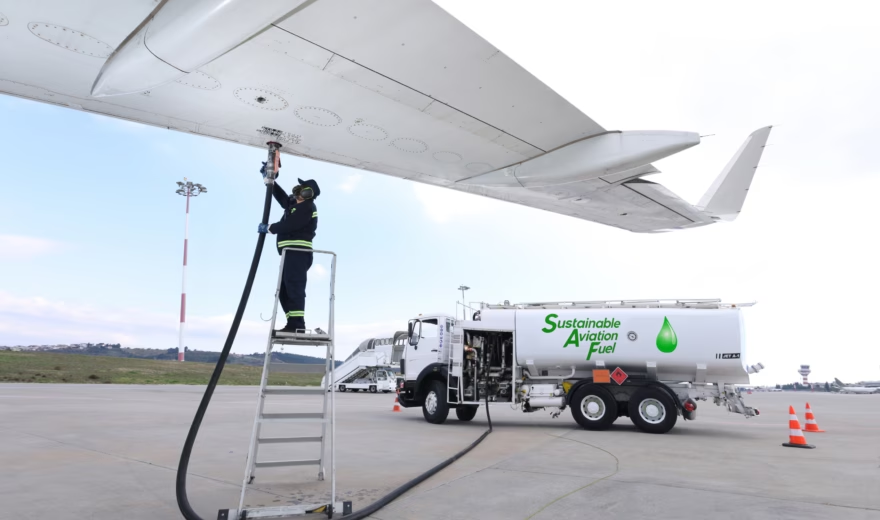
An airplane is being refueled with sustainable jet fuel on the airport tarmac.
01 Jul 2025

ReFuelEU aviation compliance in 2024: Verification coverage, challenges and upcoming operator requirements

ReFuelEU Aviation (Regulation 2023/2405) is the EU's bold initiative to decarbonize aviation by promoting greater use of sustainable aviation fuels (SAF) and reducing inefficient economic fueling. By 2024, 358 operators were subject to the ReFuelEU requirements, and Normec Verifavia independently verified 128 of them, accounting for a 35.8% market share. However, only 14 of the verified operators met the critical Article 5.1 requirement - at least 90% of their fuel refueling at Union airports. This gap highlights widespread data control and operational planning challenges. As penalties will be imposed for noncompliance in the coming year, early action, accurate reporting and effective verification practices are essential for meaningful compliance and progress toward greater use of sustainable aviation fuels.

Sign up for the newsletter

Stay up to date on the latest news, exclusive updates, and valuable insights.

Sign up

Fill in the form and you’ll receive our newsletter shortly.

Naam
Privacy Policy 

Related services

CORSIA verification

View of an urban area from an airplane during a flight.

EU ETS verification for aviation emissions

A passenger plane is flying at cruising altitude above a layer of clouds.

Aviation & SAF

ISCC certification