UK ETS for Shipping
Since July 1, 2026, the maritime sector has been covered by the UK Emissions Trading Scheme (UK ETS). Commercial cargo and passenger ships of 5,000 GT or more calling at UK ports must monitor, report, and have their greenhouse gas emissions independently verified. In addition, operators must surrender sufficient United Kingdom Allowances (UKAs) to cover the emissions covered by the scheme.
The UK ETS applies regardless of a ship’s flag and covers CO₂, methane (CH₄), and nitrous oxide (N₂O). Starting January 1, 2027, offshore vessels of 5,000 GT or more will also fall within the scope. The previous UK MRV regulations were repealed as of April 3, 2026. Since then, maritime emissions have been regulated under the UK ETS.
How the UK ETS Process Works
UK ETS compliance is managed at the company level—from defining your approach to submitting the required emission allowances. The process consists of five steps.
UK ETS Process
-
1.
1. Emissions Monitoring Plan (EMP)
Develop an Emissions Monitoring Plan (EMP) at the company level. In this plan, you outline how you will monitor the emissions from all ships covered by the UK ETS. You must submit the plan via METS to the designated UK regulator for approval.
-
2.
2. Monitoring Emissions
Monitor and record the emissions of all ships within the scope during the reporting period. Do this in accordance with the approved Emissions Monitoring Plan.
-
3.
3. Annual Emissions Report (AER)
At the end of the reporting period, prepare an Annual Emissions Report (AER) at the company level. In this report, compile the emissions data for all ships covered by your UK ETS obligations.
-
4.
4. Independent Verification
A UKAS-accredited verifier reviews the Annual Emissions Report. This determines whether your emissions reporting complies with the monitoring and reporting requirements of the UK ETS.
-
5.
5. Surrender UK Allowances
Submit the verified Annual Emissions Report via METS. You will then surrender sufficient United Kingdom Allowances (UKAs) through the UK Emissions Registry to meet your annual obligations.

Mastering Monitoring, Reporting, and Verification
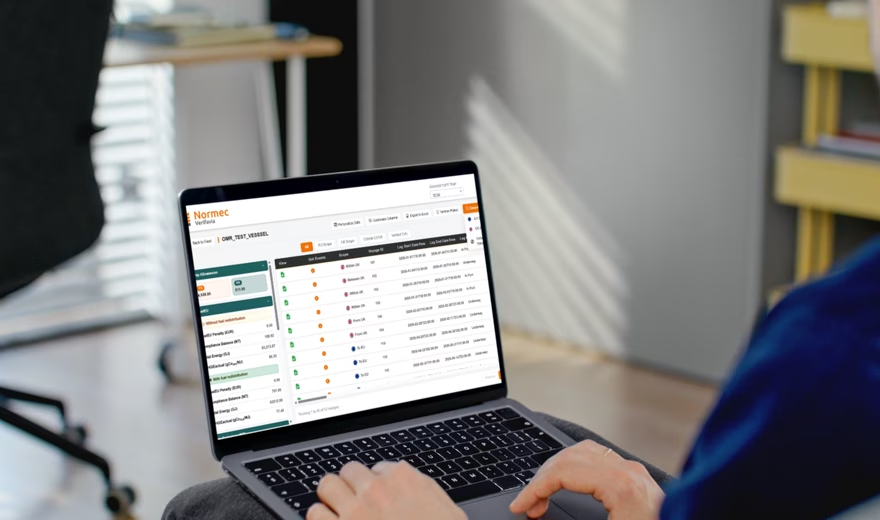
Reliable UK ETS reporting starts with accurate emissions data. Normec Verifavia combines maritime verification expertise with digital processes for collecting, validating, and verifying data. This reduces manual work and helps improve the quality of your data.
Our structured approach supports you in efficiently preparing your Annual Emissions Report and ensuring its independent verification.
This helps you:
- Collect and monitor emissions data in a structured manner
- Identify missing or incorrect information early on
- Prepare your Annual Emissions Report efficiently
- Have your emissions data independently verified
- Be prepared in a timely manner for reporting and submitting UKAs
The expansion of accreditation for UK ETS verification is currently pending. You can already submit your emissions data and supporting documentation to prepare for the verification process in a timely manner.
Which ships and emissions are covered by the UK ETS?
The UK ETS applies to commercial cargo and passenger ships of 5,000 GT or more that call at UK ports. Starting January 1, 2027, offshore vessels of 5,000 GT or more will also be covered by the scheme. The UK ETS covers CO₂, CH₄, and N₂O and calculates greenhouse gas emissions on a tank-to-wake basis. Methane and nitrous oxide are converted to CO₂ equivalents (CO₂e).
The emissions that count depend on the route. For voyages between UK ports, emissions at sea and in port are fully counted. For voyages between Great Britain and Northern Ireland, a partial obligation applies. For voyages between the United Kingdom and international or EU/EEA ports, only emissions occurring during a stay in a British port are covered by the regulation.
Exceptions apply to specific ships and activities, such as certain non-commercial government activities, commercial fishing, and certain ferry services in Scotland. The current 5,000 GT threshold and the framework for exemptions will be reassessed in 2028. This review will also consider a possible reduction of the threshold to 400 GT.
From Emissions Reporting to UK Allowances
In addition to reporting requirements, the UK ETS also has financial implications. Operators must purchase UK Allowances (UKAs) corresponding to their verified greenhouse gas emissions. No free UKAs are allocated to the shipping sector. Emissions allowances are available through government auctions or the secondary carbon market. European Union Emissions Allowances (EUAs) cannot be used for the UK ETS.
It is therefore important to clearly define commercial responsibilities as well. The UK government does not prescribe how carbon costs are to be allocated between shipowners and charterers. Therefore, establish clear agreements regarding the purchase of UKAs, the sharing of emissions data, the allocation of carbon costs, and liability in the event of non-compliance.
The first reporting period runs from July 1 through December 31, 2026. The first verified AER must be submitted by March 31, 2027. The first deadline for submitting UKAs is April 30, 2028, and covers both the second half of 2026 and the entire 2027 reporting year
Ready to prepare for the UK ETS?
Normec Verifavia supports shipowners, ship managers, and maritime operators with monitoring, reporting, and independent verification of emissions data within the UK ETS.
You might also be interested in these services




Frequently Asked Questions About the UK ETS for Shipping
-
As of July 1, 2026, the UK ETS applies to commercial cargo and passenger ships of 5,000 GT or more that call at British ports, regardless of their flag. Offshore vessels of 5,000 GT or more will be subject to the scheme as of January 1, 2027.
-
The percentage of emissions that counts depends on the route:
- 100% of emissions at sea and in port for voyages between UK ports;
- 50% at sea and 100% in port for voyages between Great Britain and Northern Ireland;
- 0% at sea and 100% while in a British port for voyages between the United Kingdom and international or EU/EEA ports.
For voyages involving UK Overseas Territories and Crown Dependencies, only emissions during stays in UK ports are covered by the system.
-
The Registered Owner is legally responsible for compliance with the UK ETS. This responsibility can be formally transferred to the ISM Company or DOC holder via a signed mandate or a legally binding agreement.
Clearly define who is responsible for monitoring, reporting, submitting UKAs, and allocating carbon costs.
-
You prepare a company-level Emissions Monitoring Plan and then monitor the emissions of all ships within the scope. At the end of the reporting period, you prepare an Annual Emissions Report and have it independently verified.
You submit the verified report via METS. You then submit the required UKAs through the UK Emissions Registry.
-
The UK ETS uses two digital systems. Through METS, you submit documents such as the Emissions Monitoring Plan and the Annual Emissions Report and communicate with the regulator.
You use the UK Emissions Registry to receive, transfer, and surrender UKAs. No physical Document of Compliance is issued within the UK ETS.
-
A civil fine of £100 per metric ton of CO₂e may be imposed for emissions not covered by submitted UKAs. Paying the fine does not replace the original obligation. You must still purchase and submit the missing UKAs. Persistent non-compliance may also lead to further enforcement actions and reputational risks.
-
Normec Verifavia supports you with the independent verification of emissions data and your Annual Emissions Report. With maritime expertise, digital integrations, and a structured verification process, we help you monitor data quality and ensure you’re prepared for your reporting obligations in a timely manner.
The expansion of our accreditation for UK ETS verification is currently pending. You can already submit your emissions data and supporting documentation to prepare for the process.